Rebluing part of a bayonet?

Collapse
X
 
  • Time
  • Show
Clear All
new posts
  • IditarodJoe
    Senior Member
    • Sep 2009
    • 1529

    #1

    Rebluing part of a bayonet?

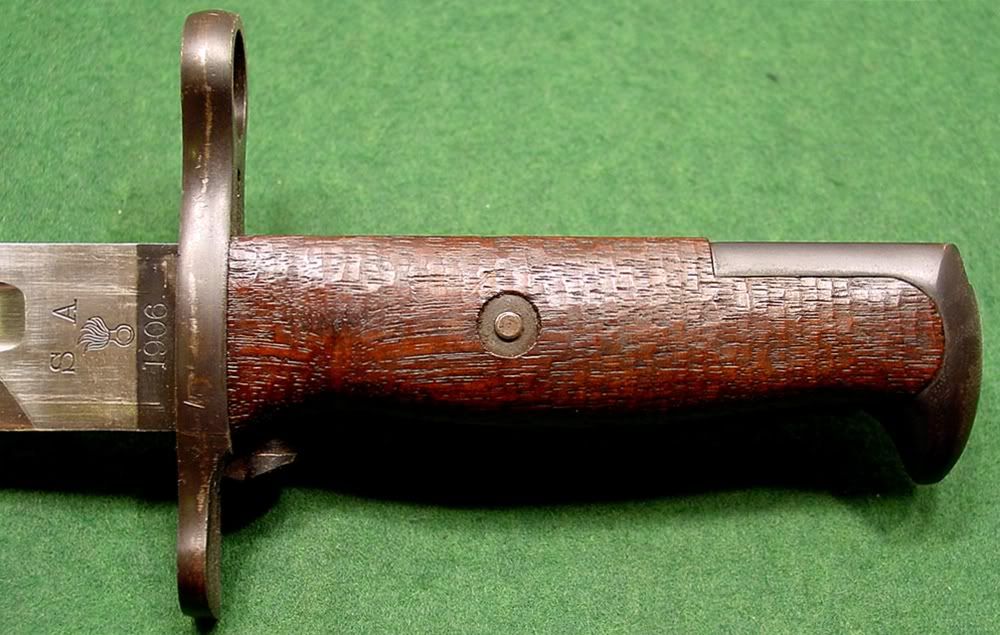
    I recently purchased a low s/n 1905 bayonet (made in early 1906) that I am going to “restore”. The bayonet underwent the 1907 alterations and is in overall very good condition, except that at some point in its life the blade was shortened by three-quarters of an inch and the entire bayonet was plated (either chrome or nickle - I can’t tell the difference). At this point, it has no collector value, so I figure I can't hurt it too badly.

    I have access to an aerospace metal finishing company that says they can remove the plating for me, but I’m not sure where to go from there. According to Brophy, the bayonet was niter blued to about 1/4 inch ahead of the crosspiece and the blade was polished bright metal.

    Has anyone here had any experience with having “part of” a bayonet reblued?

    Any advice or insight will be appreciated.
    "They've took the fun out of running the race. You never see a campfire anywhere. There's never any time for visiting." - Joe Redington Sr., 1997
  • JB White
    Senior Member
    • Aug 2009
    • 13371

    #2
    British blades were suspended by the blade and lowered into the solution. I would imagine something similar with US bayonets finished in that manner.
    2016 Chicago Cubs. MLB Champions!


    **Never quite as old as the other old farts**

    Comment

    • IditarodJoe
      Senior Member
      • Sep 2009
      • 1529

      #3
      Thank you for that piece of information, JB. I've been looking for a good photo of an original early 1905 to determine how "crisp" or "sharp" the line is between the blued portion and the polished metal of the blade. I would think that simply suspending the bayonet over/in the bluing tank would result in a somewhat hazy boundry. If the originals have a sharp line betweeen the two areas, I would be inclined to think that some sort of masking or pre-coating of the bare metal was involved.

      Does anyone have a good photo I could use as a reference?
      "They've took the fun out of running the race. You never see a campfire anywhere. There's never any time for visiting." - Joe Redington Sr., 1997

      Comment

      • Bayonetman
        Member
        • Aug 2009
        • 80

        #4
        Here is one:

        Last edited by Bayonetman; 08-21-2010, 05:44. Reason: Resize Photo

        Comment

        • Nick Riviezzo
          Senior Member
          • Aug 2009
          • 1503

          #5
          I really don't know anything about this subject but the logical conclusion,for me, is blue the whole bayo and polish/grind off what doesn't need to be there.That will give you the desired texture on the blade and a straight line of"departure"wouldn't it? Nick

          Comment

          • dave
            Senior Member
            • Aug 2009
            • 6778

            #6
            Do not take that 1/4" as written in stone. I have seen many that it is allot less. Mine is 1/16" and it is original 1906 RIA.
            You can never go home again.

            Comment

            • IditarodJoe
              Senior Member
              • Sep 2009
              • 1529

              #7
              That's a great photo, bayonetman! Does that straight edge continue evenly around the upper and lower edges? The crispness of that boundry would seem to me to rule out the suspension approach in the bluing tank, as any motion of the surface of the bluing solution would make a more blurred transition.

              I hadn't thought about Nick's suggestion. If my understanding is correct, for a very short time at the beginning of WWI the blades, as issued, were entirely blued. If the blades have previously been entirely blued and then the unwanted blue polished off, the elimination of the polishing step would have been a logical wartime expediant. How difficult would it be to polish off unwanted bluing?

              Here's an interesting update. The bayonet is currently at the metal finishers being stripped. When I took it in, they told me that when "decorative chrome" is applied the common procedure is to first nickel plate the piece and then to apply chrome plating over the nickel. According to their expert, this was the case with my bayonet.

              I should have the stripped parts back this week and will post "before and after" pictures of the result.
              "They've took the fun out of running the race. You never see a campfire anywhere. There's never any time for visiting." - Joe Redington Sr., 1997

              Comment

              • Bayonetman
                Member
                • Aug 2009
                • 80

                #8
                Yes, the line of blue is consistent around the blade.

                The width of the line of blue is not totally consistent, but remains very close with Springfield Armory being about 1/4 inch, and Rock Island being somewhat less, in the area of 1/16th to 3/32 inch. However, there are exceptions to both.

                There has been a lot of discussion over the years as to how the bluing was done. The idea that they were blued overall and then the unwanted bluing was polished off has been discussed, and may well be correct. However, I have no definite information as to how this was done.
                Last edited by Bayonetman; 08-22-2010, 01:31. Reason: Spelling error

                Comment

                • Nick Riviezzo
                  Senior Member
                  • Aug 2009
                  • 1503

                  #9
                  Again, coming up with"brainy ideas" that I know nothing about,would it be feasable to blue the whole thing and remove what and where you want with Naval Jelly?You could maybe mask your line with electrical tape to get a clean line.For sure I know nothing about bayos[except how to use one] but I'm trying to think of a shop[shadetree] procedure that would work for you. Nick

                  Comment

                  • Johnny P
                    Senior Member
                    • Aug 2009
                    • 6260

                    #10
                    There were no blueing tanks when the SA and RIA bayonets were made. The two blueing types available at the time was rust blue (called browning), and niter blue which was a heat blue. The hot tank caustic blue did not come into general use until the 1930's.
                    The niter blue produces a beautiful blue, with the higher the polish of the metal, the brighter the blue. In the niter blueing the part is repeatedly dipped into a mixture of potassium of nitrate and oxide of manganese heated to 800 degrees F. It would have been easy enough to suspend the bayonet handle down into the mixture, as the process was probably done by hand, and then polish the blue back to a smooth line.
                    On the bayonet you can see that the polish line was not straight, and is lower on the right than on the left.

                    Comment

                    • wsfbernie
                      Senior Member
                      • May 2010
                      • 192

                      #11
                      In my bayo collection, I have a 1917 dated SA to match my m1903 1917 dated rifle. I also have the older "two-tone" and newer
                      parkerized (1918) bayos. So far, I have only been able to find info saying the 1917 ONLY had a complete blue job. In fact, my 1917
                      unit is beautifully blue. Prior to 1917, the bayos were two toned and from 1918 on parkered. Most pictures of WWI show the bright
                      blades on the m1905 bayo being used by AEF. I have read that the parkering and bluing was done only to subdue the surface
                      brightness and not for metal protection.

                      Comment

                      • IditarodJoe
                        Senior Member
                        • Sep 2009
                        • 1529

                        #12
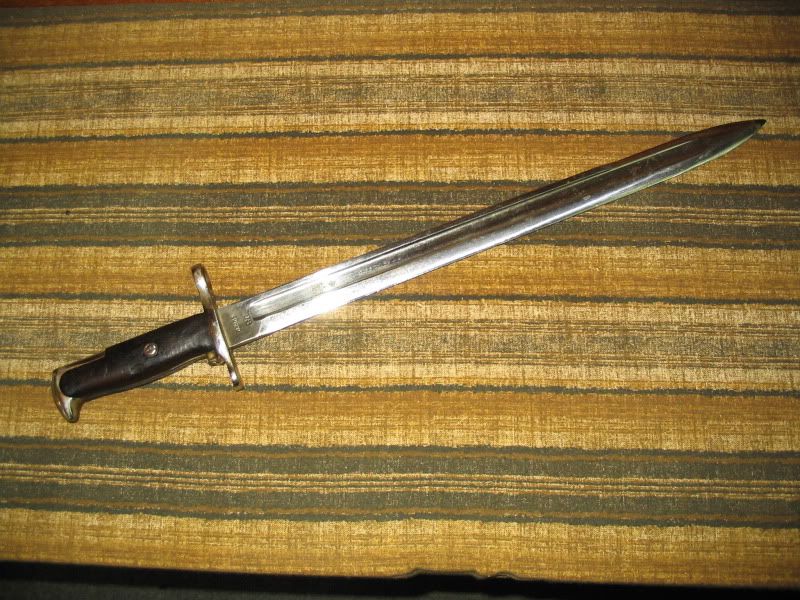
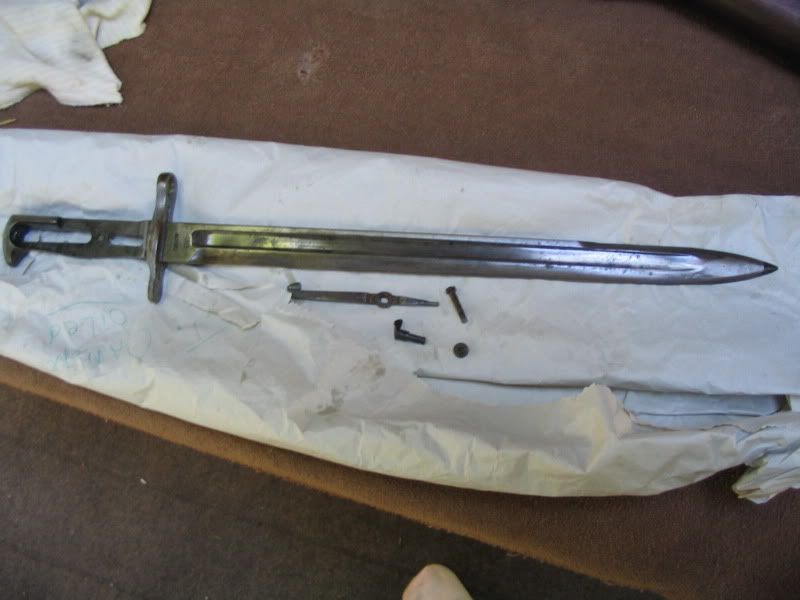
                        My 1906 bayonet before stripping of the nickel-chrome plating


                        and after


                        I'm really pleased with the way it came out. The "after" photo makes it look a little pitted, but it isn't at all . . . just smooth bare metal with a little coating of RIG. Now to get it reblued. I've contacted Johnson Small Arms in Northwood, NH. They advertise that they do nitre bluing. Has anyone here had any experience with them?
                        Last edited by IditarodJoe; 09-04-2010, 02:30.
                        "They've took the fun out of running the race. You never see a campfire anywhere. There's never any time for visiting." - Joe Redington Sr., 1997

                        Comment

                        • JB White
                          Senior Member
                          • Aug 2009
                          • 13371

                          #13
                          How do you plan to address the difference between the original aged and worn grips to a freshly blued finish?
                          2016 Chicago Cubs. MLB Champions!


                          **Never quite as old as the other old farts**

                          Comment

                          • IditarodJoe
                            Senior Member
                            • Sep 2009
                            • 1529

                            #14
                            Well JB . . .that there is a darned good question! Any suggestions?
                            "They've took the fun out of running the race. You never see a campfire anywhere. There's never any time for visiting." - Joe Redington Sr., 1997

                            Comment

                            • IditarodJoe
                              Senior Member
                              • Sep 2009
                              • 1529

                              #15
                              As I see it, I have three options:

                              1. I could buy a set of NOS (read "Chinese") walnut grips, replace the worn scabbard cover with a new reproduction cover, and have a new-looking "restoration" .

                              2. I could try to find out what well used 104 year old nitre bluing looks like and try to have it refinished to "look right" with the old grips and scabbard.

                              3. I could "rearsenal" it. My 1943 Garand came straight from a 1965 arsenal overhaul with the original, worn 1943 walnut lower handguard and a brand new, barely finished birch upper handguard. Those arsenal armorers didn't really care whether parts matched in terms of wear.

                              At some point, this bayonet has been shortened by 3/4 inch (my guess would be to restore a broken tip). It's been chromed, stripped, and will be refinished. It will never be a collector item. By the time I've finished messing with it, I could probably have bought an original one for about the same $$. So either I'm "a few rounds shy of a full clip" (likely) or it's just a labor of love.

                              What can I say . . .
                              "They've took the fun out of running the race. You never see a campfire anywhere. There's never any time for visiting." - Joe Redington Sr., 1997

                              Comment

                              Working...