Confusion on LN 03's

Collapse
X
 
  • Time
  • Show
Clear All
new posts
  • slamfire
    Senior Member
    • Aug 2009
    • 221

    #31
    Code:
    ..... And that single heat treat rifles were blowing up all around, had been blowing up since they were made, and instead of the Army acknowledging that they built structurally deficient rifles, the Army blamed grease....
    A total of 92 known reported damaged 1903 receivers is "blowing up all around"? Got any idea how many hundreds thousands of rounds, maybe millions, were fired in LN 03's in WWI and WWII? The facts do not support your statement. The ordnance reports I read do not blame greased bullets.
    I assume your number came from Hatcher's Notebook, a list which starts in 1917 and ends 1927. (I am working off on memory on the dates) There were low number 03's that blew before the records start, I know of a few from the early Arms and the Man. There are people who have kept track of the number of blown 03's that have been reported on the web, and there are double heat treat receivers in that mix. And, Hatcher's list ends in 1927 or thereabouts and there are known low numbers that blew up in service after the list. Just search the Springfield Armory website and you will find pictures. Hatcher's database is not a complete record and anyone making conclusions based on it are being optimistic to say the least.

    What you also don't know, is the "the number". That board that recommended scrapping what was close to a half a billion dollars (today's money) of low number 03's wrote a report and in it, was "the number". For the report to be useful as a decision paper it had to have "the number" in order for decision makers to have all the data. "The number" was the estimate of the number of structurally deficient receivers in service. Hatcher never released that number, did he?, but it had to be big. It was big enough that the Army decided to scrap all million 03's when they eventually came into rebuild.

    Now, in my opinion, that is an immoral decision. They knew by keeping these rifles in service until such time they wore out, or blew up, that the ones that blew up would injure Soldiers, Sailors, and Marines, and yet, the life or health of a Service man was worth less than a $40.00 rifle.

    The fact that the Army did decide to scrap a half a billion dollars of rifles shows they did consider the number large enough to be a real problem.

    However, if you want to shoot your low number receiver, go ahead. You may have one of the "good ones". If your low number does not blow up on you, then you made the correct decision. If it does, then you made a poor decision. After all these don't come with a warranty and there is no one to sue to collect medical expenses.

    Now in my opinion, instead of asking people to prove these rifles are "unsafe", given that the blow up of one of these involves permanent injury, the burden of proof ought to be on those advocating the use. You should prove these are "safe" to use. Given that the Army decided to scrap all these rifles, why then are they "safe"?
    Last edited by slamfire; 01-25-2014, 06:00.

    Comment

    • Marine A5 Sniper Rifle
      Senior Member
      • Aug 2009
      • 7450

      #32
      Have you seen me advocate their use?

      jt

      Comment

      • PhillipM
        Very Senior Member - OFC
        • Aug 2009
        • 5937

        #33
        Originally posted by slamfire
        Given that the Army decided to scrap all these rifles, why then are they "safe"?
        Frankford Arsenal 1925...Scrap them all, they are dangerous! Springfield Armory 1926 they are dangerous if there is an overpressure event or if there is excessive headspace. The Board recommended that the receivers be withdrawn from service and scrapped.

        After considering the proceedings of the Board, the Chief of Field Service, Brigadier General Samuel Hof, on February 7, 1928, made the following recommendation of the Chief of Ordnance, which was approved as a policy:

        "Our ammunition is getting worse and accidents may be somewhat more frequent. On the other hand, some of theses early rifles have been in use for many years and undoubtedly some of them have worn out several barrels. I do not think the occasion merits the withdrawal of the rifles of low numbers in the hands of troops until the rifle is otherwise unserviceable. On the other hand, I do not think we are justified in issuing such rifles from our establishments. I recommend that we instruct our Ordnance establishments to no longer issue rifles with these questionable receivers, that such rifles be set aside and considered as a war reserve and the question of the ultimate replacement of the receivers be deferred. When rifles are turned in from the troops for repair the receivers having these low numbers should be scrapped."

        Only low number rifles in need of repair were recommended to be scrapped. All others were fit for combat use as official policy of the United States Army.
        Phillip McGregor (OFC)
        "I am neither a fire arms nor a ballistics expert, but I was a combat infantry officer in the Great War, and I absolutely know that the bullet from an infantry rifle has to be able to shoot through things." General Douglas MacArthur

        Comment

        • PhillipM
          Very Senior Member - OFC
          • Aug 2009
          • 5937

          #34
          Originally posted by slamfire
          From 1906 to 1918 the Army had a systemic quality control failure at their Arsenals, ...
          I'm glad serial number 36018 I own made in 1904 is outside your window of failure.
          Phillip McGregor (OFC)
          "I am neither a fire arms nor a ballistics expert, but I was a combat infantry officer in the Great War, and I absolutely know that the bullet from an infantry rifle has to be able to shoot through things." General Douglas MacArthur

          Comment

          • Johnny P
            Senior Member
            • Aug 2009
            • 6259

            #35
            The same brittle receivers, the same soft ammunition, and not a reported receiver failure in the trenches of France?

            Comment

            • jgaynor
              Senior Member
              • Nov 2009
              • 1287

              #36
              Originally posted by Marine A5 Sniper
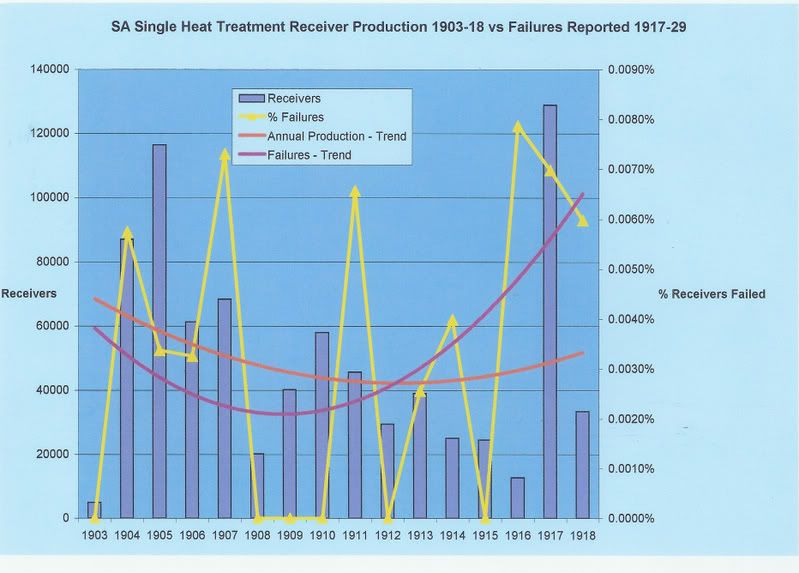
              You might want to read the official ordnance reports Hatcher referenced and compare them to his report. I tried to post a table of all known (from ordnance reports and SRS) failures but it looks like crap when posted. I could only find 157 reported failures, and only 92 of those suffered receiver damage. Many of the causes of receiver failures would have damaged modern receivers. If someone can explain how to post an Excel database, I will post it for all to see.

              Rick, one of the failures was a Philippine rifle. :-)

              jt
              Jim, if you can get your graph on a single page.
              1. Print it
              2. Scan the file saving it as a .jpg (make sure the file size does not violate any attachment limits of this forum)
              3. Post using "Go Advanced & Manage Attachments"

              Alternatively save it to a service like photobucket and post the link.

              Esentially you are just taking a picture of the graph and dealing with it like any photo.

              Regards,

              Jim

              I used this technique to post the following graph five or six years ago. Its based on the Hatcher data for SA only. It shows failures as a percentage of the total manufactured. if i get motivated i will try to display the dates of the accidents. For a rough average calulations just add 12 years to the date of manufacture
              Last edited by jgaynor; 01-26-2014, 07:13.

              Comment

              • ClaudeH
                Senior Member
                • Aug 2009
                • 199

                #37
                Originally posted by jgaynor
                Jim, if you can get your graph on a single page.
                1. Print it
                2. Scan the file saving it as a .jpg (make sure the file size does not violate any attachment limits of this forum)
                3. Post using "Go Advanced & Manage Attachments"

                Alternatively save it to a service like photobucket and post the link.

                Esentially you are just taking a picture of the graph and dealing with it like any photo.

                Regards,

                Jim

                I used this technique to post the following graph five or six years ago. Its based on the Hatcher data for SA only. It shows failures as a percentage of the total manufactured. if i get motivated i will try to display the dates of the accidents. For a rough average calulations just add 12 years to the date of manufacture
                http://img.photobucket.com/albums/v2...tRcvrGraph.jpg
                Also, if you have Adobe (not acrobat) or another .pdf print utility like deskpdf, you can just print the spreadsheet as a pdf in the first place.
                Last edited by ClaudeH; 01-26-2014, 10:54.

                Comment

                • ClaudeH
                  Senior Member
                  • Aug 2009
                  • 199

                  #38
                  As for grease in the chamber neck, Mr. Wizard on the TV program of my youth, Mr. Wizard's Science Secrets demonstrated an interesting experiment involving the difficulty of quickly displacing a fluid - even as thin as air. He put a wooden yardstick on a table extending about halfway off the side, covered it with a single sheet of newspaper, illustrated how easily you could raise the sheet of newspaper >slowly< by pressing the protruding end of the yardstick, and then gave the end of the yardstick a sudden slap and broke it in half without disturbing the sheet of newspaper.

                  I believe grease in the chamber neck set up the same effect. It was too viscuous to suddely be displaced out of the chamber neck by the otherwise expanding case neck and and behaved the same as an overly long case neck jammed into the leade - it created an overpressure event. If, indeed, it was only the ability of the case neck to break the solder joint by expanding away from the bullet, and if the chamber neck was clogged with grease and preventing that case neck expansion, I think an incredible over-pressure event could occur.

                  I don't think those >wax< wads at the neck of Swiss ammo represent the same hazard. That wax is relatively hard and probably vaporizes in the heat of firing, leaving no significant residue- just like with wax-coated moly-plated bullets. Also, that wax ring is far more carefully placed than the grease on a bullet that is just informally shoved into a container of grease. That would grease the entire bullet and undoubtedly grease up the chamber neck, but the wax ring is already being mostly centered in the chamber neck by the uncoated forward portion of the bullet.
                  Last edited by ClaudeH; 01-26-2014, 11:09.

                  Comment

                  • Parashooter
                    Senior Member
                    • Aug 2009
                    • 819

                    #39
                    I wouldn't make too much of the Swiss GP11 sealant/lube as a point of comparison with greased 30/06. The usual 7.5x55 chamber is cut about 1mm longer than the maximum cartridge length, giving a space for the sealant/lube to occupy without constricting neck expansion.


                    CIP specs for the 7.5x55 Swiss give a maximum cartridge length of 55.60mm and a minimum chamber length of 56.35mm, a 0.75mm difference. (The Swiss military model 1911 and 1931 chambers I've measured are consistently a bit longer.) For comparison, CIP "30-06 Spring." specs are 63.35 cartridge maxi and 63.55 chamber mini - just 0.2mm difference.

                    Comment

                    • slamfire
                      Senior Member
                      • Aug 2009
                      • 221

                      #40
                      I wouldn't make too much of the Swiss GP11 sealant/lube as a point of comparison with greased 30/06. The usual 7.5x55 chamber is cut about 1mm longer than the maximum cartridge length, giving a space for the sealant/lube to occupy without constricting neck expansion.


                      CIP specs for the 7.5x55 Swiss give a maximum cartridge length of 55.60mm and a minimum chamber length of 56.35mm, a 0.75mm difference. (The Swiss military model 1911 and 1931 chambers I've measured are consistently a bit longer.) For comparison, CIP "30-06 Spring." specs are 63.35 cartridge maxi and 63.55 chamber mini - just 0.2mm difference.

                      There is a difference but, unless you know original design intent, you don’t know why the Swiss cut their chambers a little longer. Maybe it is was due to grease clearance, mud clearance, or something else.
                      But I am not worried due to the number of 303 British, 308 cartridges that I have fired with greased bullets and greased cases.

                      The Royal Society has the right idea: Their motto is to “accept nothing on authority.” Knowledge is to be based on observations/tests in the physical world, and if authority conflicts with these observations, then authority is wrong. There has always been a continuing fight against dogma created by authority figures.

                      Based on my observations greased bullets, greased cases do not raise pressures. Grease does not pinch the bullet in the case neck, and I believe it is because as pressure builds in a case the neck starts expanding from behind the bullet, rolling forward toward the case mouth until the bullet is released. This has the effect of moving the grease, grease may be “incompressible” but it is not immovable.

                      I fired over 1000 rounds of greased 303 British and I greased the heck out of 308 Cavim. I had a case of the stuff, maybe 1500 rounds, currently the brass fills two complete 50 caliber ammunition cans. I wanted to fire the stuff in my FAL, I did not want the cases to stretch, so I put ammunition in plastic bags, dropped in tablespoons worth (actually fingerdips) of Casteroil stick wax in the bags and shook the stuff. Stick wax was a bad idea. Stick wax http://www.freemansupply.com/CastrolIloformStic.htm is tenacious stuff, it is meant to stick to saw blades as they cut through metal or ceramic. Casteroil stick wax is very thick and did not apply smoothly. After shaking in a bag, I had huge clumps of stick wax all over the ammunition. When I loaded and fired the stuff a mist of stick wax formed in the air. The rifle was coated, my clothes were coated, my glasses were coated, and the stuff does not wash off in plain water. But something interesting happened. I was able to open the gas system in my FAL by more than a couple of clicks and still have reliable function. For those who don’t have a FAL, you adjust the cycling by bleeding off gas until the bolt is no longer held by the follower. Then you add a click or two. I was able to verify that lubricated ammunition reduced breech friction significantly, and by increasing the gas bleed, made the rifle cycle smoother and with less banging and slamming.

                      Still, the plume of stick wax was objectionable and I ended up wiping down the cases. I left stick wax on, but not in the thick, clumpy quantities. The cases were covered from head to toe with a thin coating of stick wax, and I shot them that way. Shot them in bolt rifles, M1a’s, FAL’s, anything of mine that was in 308.

                      Since I don’t have copper fouling problems with modern jacketed bullets I don’t have to grease my bullets, but I lubricate my cases and have not encountered any pressure issues. I have shot out two barrels on one M1a, another on another, shot out match 308 barrels, one AR15 barrel, no problems.

                      Those who have the energy to go page by page from every Arms and the Man at Google books, such as I, will find that pre WW1, greasing bullets was the norm. Shooters are bragging about the accuracy, about shooting 3000, 7000 greased rounds without bore fouling or cleaning. There are actually pictures of greasing devices, for clubs! However I notice a tension in the articles of shooters: while they don’t see evidence of harm in their own rifles and ammunition, yet rifles are blowing up and behind the scenes the Ordnance Department must be claiming the blow up’s are due to grease. Not until 1918 does the Army actually put out a statement in print that Army rifles do not blow up more frequently than any other rifle and when an 03 blows up, it is due to shooter stupidity. Incidentally, this is after the production of single heat treat receivers is discontinued. No one outside of the Ordnance Department is aware of the dangerously defective rifles the Army is manufacturing, issuing and selling, and the Army is not telling.
                      Last edited by slamfire; 01-27-2014, 02:31.

                      Comment

                      • slamfire
                        Senior Member
                        • Aug 2009
                        • 221

                        #41
                        Originally posted by Johnny P
                        The same brittle receivers, the same soft ammunition, and not a reported receiver failure in the trenches of France?
                        Your post raises two issues: What was the primary rifle in France? Based on what I have seen and read, only the Marines carried the 03 into Europe, the US Army carried the M1917. I am aware, from American Rifleman articles, that Regular Army Units were relieved of their 03's and given M1917's before shipping across. This was how 03 serial number one was found, the Private who had the rifle did not want to give it up, he created enough of a fuss that his unique rifle was identified to authority. I would like someone to give number of the actual 03’s that were in Europe.

                        And I believe this why not a word of the defective single heat treat rifles appears in print, or in a whisper, during WW1 or years after. If an adult had been in charge of the War Department and found that all of those one million 03’s made to date were suspect, the correct decision would have been to stop wasting money, stop production, and use M1917’s. There were over two million M1917’s made, more than enough to arm the AEF, the rifle was 100% successful as a combat rifle, and it was a more advanced combat rifle than the 03. However, the M1917 was made outside the Government Arsenal system. The Army wanted to keep their Arsenal lines going and they liked the 03.

                        The second question is how did Hatcher get these safety reports? Safety incident reports are not released to the public or to anyone in the Army. Only Safety investigators and law enforcement have access. That is why you cannot find anything about Army accidents, incidents, etc, in the public domain. The only reports you will find are those that are so scandalous that they make the evening news. Following your logic, since there are zero reports, there are no accidents, now, or then. To pry anything out, you need to get a lawyer and work a FOIA. Good luck on finding an accident report database from 1917.
                        Last edited by slamfire; 01-27-2014, 02:04.

                        Comment

                        • slamfire
                          Senior Member
                          • Aug 2009
                          • 221

                          #42
                          After considering the proceedings of the Board, the Chief of Field Service, Brigadier General Samuel Hof, on February 7, 1928, made the following recommendation of the Chief of Ordnance, which was approved as a policy:

                          "Our ammunition is getting worse and accidents may be somewhat more frequent. On the other hand, some of theses early rifles have been in use for many years and undoubtedly some of them have worn out several barrels. I do not think the occasion merits the withdrawal of the rifles of low numbers in the hands of troops until the rifle is otherwise unserviceable. On the other hand, I do not think we are justified in issuing such rifles from our establishments. I recommend that we instruct our Ordnance establishments to no longer issue rifles with these questionable receivers, that such rifles be set aside and considered as a war reserve and the question of the ultimate replacement of the receivers be deferred. When rifles are turned in from the troops for repair the receivers having these low numbers should be scrapped."

                          Only low number rifles in need of repair were recommended to be scrapped. All others were fit for combat use as official policy of the United States Army.
                          At the time, it would have been the low cost solution for the Army. The Army did not have to go to Capital Hill at a time when Congress was funding, essentially nothing, for National Defense, and beg for money. Times were mean back then. There were no social services, no food stamps, no welfare. If you were not working, you were not eating Typically an industrial worker received a lump sum, if that, for an on the job injury. The worker went home, never drew a paycheck, was a burden on his family. Then, injuries were handled similar to College Sports today; the College is only responsible for stabilizing the injured student. Once the student is able to walk and talk, he is discharged from the hospital. If he can’t play, he loses his scholarship and goes home. If he requires long term continuing medical care, it is on his dime. Prior to WW1 this was the same in the military . But, after WW1 any injured Soldier/Sailor/Marine could fight the precursors to the VA to get benefits.

                          http://www.va.gov/opa/publications/a...y_in_brief.pdf “The Vocational Rehabilitation Act of 1918 authorized the establishment of an independent agency, the Federal Board for Vocational Education. Under the new law, any honorably discharged disabled veteran of World War I was eligible for vocational rehabilitation training. Those incapable of carrying on a gainful occupation were also eligible for special maintenance allowances. The Bureau of War Risk Insurance was responsible for screening veterans for eligibility. A 1919 law fixed responsibility for medical care of veterans with Public Health Service, transferred a number of military hospitals to Public Health Service.”

                          However, the funding for Rehabilitation did not come out of the Army Budget. Therefore injuring Soldier/Sailors/Marines was the low cost solution. It cost the services nothing but short term medical care.


                          So, is this Official Policy moral, or immoral?
                          Last edited by slamfire; 01-27-2014, 02:26.

                          Comment

                          • Crashyoung
                            Member
                            • Dec 2013
                            • 37

                            #43
                            Getting somewhat back on track, is there a possibility that
                            the cartridges were to blame, and politics were causing the
                            reporting to be blamed on the receivers?

                            I have seen pictures of the failures, and in some cases, the
                            cone of the barrel was sheered off by the failure. The barrels
                            and cartridges were never questioned in the failures, just the
                            receivers.

                            Another factor pointing at the cartridge is the fact the rifle
                            was provided with a case extractor. How many times in recent
                            history has anyone here had to extract a case that had ripped
                            apart in the chamber?

                            The cartridge design began with a longer case length than what
                            was standardized later. Could the wrong cartridge cases have been
                            issued or sold to the surplus market, and been the real cause
                            of the failures?

                            In some cases, the failure was blamed on a barrel obstruction.
                            Most of the reported obstructions could cause a catastrophic
                            cartridge failure, but what if the case was too long, and the
                            shooter forced the bolt closed, ramming the tip of the case
                            into the leede? Would the pinching of the bullet be enough to
                            cause an excess pressure event resulting in the cartridge to
                            rupture?

                            Being in service so long, the early number receivers should
                            have failed more often, if the receiver was the only cause of
                            the failure. Being weak or subject of fracture isn't the prime
                            reason a receiver would fail. Many people have shown the
                            early number receivers withstood many overloaded 'proof'
                            loads without incident, but no one ever tried over length
                            cartridges.

                            Case length is one of the things I always double check when
                            reloading. Modern factory cases that I have used have never
                            been too long, unless fired and resized a few times.

                            This isn't an excuse to grab the first low number rifle and
                            start shooting it. I would caution anyone to have the rifle
                            inspected before using it.

                            My latest acquisition was magnafluxed before I used it.
                            If I had access to X-ray inspection, I might just have that
                            done, just to 'see' what my receiver looks like!

                            I also visually inspect the barrel before shooting, as I have
                            found it better to be safe than sorry!

                            Comment

                            • slamfire
                              Senior Member
                              • Aug 2009
                              • 221

                              #44
                              Early ammunition had its problems too. There is no doubt, as I have read the period comments, that ammunition of the period was highly variable in quality, and did not get better with age. This is also a self inflicted wound by the Army, they bought all this stuff, certifying when they bought it that the ammunition was made to standard. Under the rush of wartime production, a lot of substandard stuff was shipped. This is true for any war, you just have to read the accounts of the people who were there.

                              Even in peacetime, period production philosophy was quite different from today. They stuck Quality Inspectors at the end of the lines and it was their job to sort out the good from the bad. This philosophy extended to the 70's, a GM executive famously said (in answer to poor GM cars) that "manufacturing made it, marketing sold it and customer service made it work". GM almost went bankrupt when American's discovered cheap, reliable, Japanese cars.

                              No one should think for a moment that the process control of the period had any sophistication. Pyrometers should have been used at Springfield Armory in the forge rooms, and they were not, but then, pyrometers were new in 1901. The excuse given at the time for bursting 03 receivers was "too much case hardening". And that could have been one cause. All of this makes me believe that the WW1 era Arsenals were ships that leaked in a lot of seams. The metal used in 03 barrels was just as primitive, I have seen a number of 03 blow up pictures where the barrel gave way. Cartridges were also made under primitive process controls, a bad cartridge gives way and the metal of the receiver or barrel does not have the margin to hold up. But since the quality was so variable, maybe the next one would.

                              People today have no sense of history and no sense of the technology of the period. They project back today's technology and expect things 100 years ago to be the same as today. Well it was not. The good old days were rotten.
                              Last edited by slamfire; 01-27-2014, 06:57.

                              Comment

                              • firstflabn
                                Senior Member
                                • Aug 2010
                                • 162

                                #45
                                Great powers of concentration you have. Once the Vocational Rehabilitation Act of 1918 gets mentioned, I can hardly think of anything else.

                                Comment

                                Working...