

 Tweet
Tweet
Like many here, I have a copy of Hatcher’s Notebook, it is a valuable reference, and have read a number of its sections many times. However, I no longer consider Hatcher an infallible source, this is primarily due to his write up on grease, greased bullets, and the tin can ammunition.
If you read his chapter on Gun Corrosion, in which is the Tin Can ammunition experience, there are two points on which I strongly disagree. It has to do with the practice of greasing bullets to prevent cupro nickel jacket fouling and pressures. Hatcher states that “1, Grease increased the bolt thrust dangerously; and, 2, as if that weren’t enough, grease increased the chamber pressure dangerously”
His, or should I say the Army’s explanation for the second point, is that grease in the chamber pinches the case neck and thus prevents expansion of the case neck, thus dangerously raising pressures.
I decided to test this to see if greasing bullets would “dangerously” increase pressures. To do this, I decided to shoot heavily greased bullets, chronograph and photograph the before and after results. I used a load which literally millions of rounds were fired in competition: a 168 Match, 47.0 grains IMR 4895, LC cases.
These rounds were fired as sighting shots, to zero rifle. Bullets and chamber absolutely free from grease.
30-06 M98 Match Rifle 26" 1-10 Wilson Barrel
I subsequently shot a group which the bullets were not greased, but there was most certainly some grease residue left in the chamber from previous rounds. Note primer change.
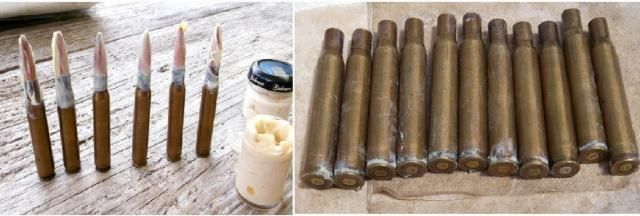
Greased bullets before and after firing
Initial rounds gave spurious reading across the chronograph, of which I wish they could have been true, for my chronograph was providing readings of 3000 fps. Velocities this high would be incredible for this load and bullet. If it had been real, and without pressure signs, the next thing I would have done was test the combination at long range. If the accuracy stayed excellent, if I could get 400 fps more velocity just by greasing the bullet, it would have been my secret. But I suspected instrumentation error and that is what it turned out to be. I moved the chronograph two feet + further from the muzzle and continued with my testing. On previous shooting sessions , when the chronograph was too close to the muzzle, or shooting magnum cartridges, or black powder, gunpowder residue crossed over the screens and created physically impossible velocity readings or displays of “err1”. As an example, I had to move my chronograph out to around 20 -25 yards to get any black powder musket velocities. The amount of powder residue blown out of the musket caused instrumentation error. For this test, I believe a mass of grease, or grease plume, created sensor error. This is why the number of shots on the targets do not correspond with the numbers in the chronograph data.
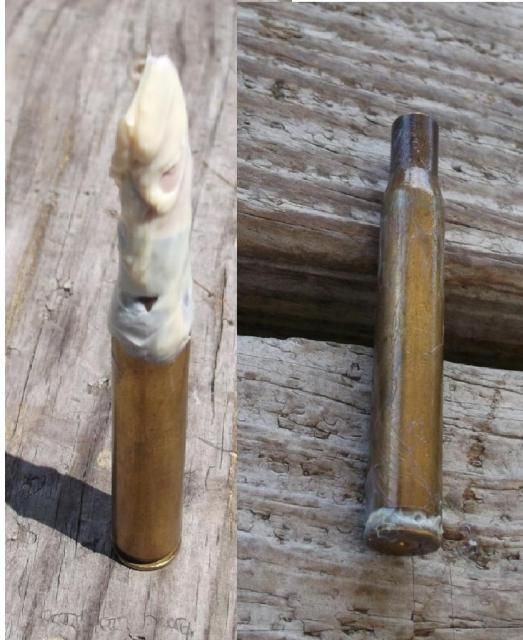
Shot #8, “Big Grease” before and after firing
At 100 yards I am of the opinion that the grease on the bullets did not cause any difference in accuracy or velocity and I did not observe any pressure indications.
Hatcher repeated an Army theory that greased bullets “dangerously” raised pressures because grease is incompressible, and that grease around the case neck “pinched” the case neck. This claim was made prior to the 1921 National Matches. While higher pressures should always give higher velocities, given that PV = nRT, pressure increases due to a thin grease layer do not follow a power law unless the volume is decreased exponentially. Without pressure measuring capabilities the only means I have of estimating pressure are inferences created after reviewing velocities, primer indications, (blown, leaking, primers, expanded primer pockets), and sticky bolt lift. I encountered none of these in any of my testing. It is possible that had I plugged the bore with grease, creating a bore obstruction, I would have experienced high pressure indications, but even so, given the huge mass of Lubriplate AA130 I put on the cartridges, if the Army’s claims were true about bullet pinching, I should have replicated the pressure problems. But I did not and I never have. This is not the first time I have shot greased cases, just the first time I have photographed greased cases, and it is the first time I have chronographed greased bullets. If, as the Army claimed, the case necks were prevented from expanding I should be able to measure this. I have measured the diameter of case necks, after firing with grease coatings, and the differences in diameter between dry and greased is within my measuring capabilities. I can’t measure a difference.
Primers of fired, greased rounds. Primers are rounded and show no evidence of pressure indications.
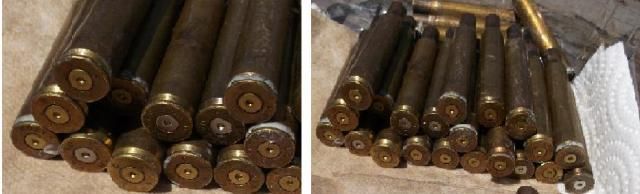
I would expect slightly higher velocities for the greased bullets, because ammunition technicians told me that in their laboratories they measured higher velocities at the same pressures for moly bullets. But given the small sample size in my shot strings, I can’t prove that one way or another. I look at the slight differences in velocities that I had for dry chamber, slightly greasy chamber, and greased chamber, as being all within the three sigma limits of what I would expect for that cartridge with that charge. That is, I don’t believe there is any significant velocity difference between any of my data strings, even though there are differences in the averages, but those are what you would normally see in velocity/pressure variations within the total population. So, based on velocities, I don’t see any evidence that grease on the case neck “pinches” the bullet.
What is totally wrong about the Army theory on “pinching” is the assumption that grease is immovable. Grease may be incompressible, but it is certainly not immovable. Under pressure, grease will flow. If it did not wheel bearings would have trouble rotating. With small arms cartridges the grease will flow because of the differences in metal thickness from the front and back of the case. Cases are thin at the front and thicken towards the back. The whole combustion event is faster than human perception, thus it seems instantaneous, but it is not. Combustion pressures take a finite amount of time to climb to maximum pressure. It can be assumed at each moment in time, the pressure within the whole case is the same, but of course, as time increases, the pressures increase. As pressures increase, the thinner parts of the case expand first, and as pressures increase more, the thicker sections expand last. This has the effect of squeezing the grease, some into the throat, and some out the action. I tried measuring the OD of the case mouths, to measure film thickness, and the layer is so thin, I can’t measure a significant difference with my measuring equipment. Between dry and lubricated cases, the case mouth expansion measurements are indistinguishable.
As can be seen in these pictures, the huge excesses of grease that I applied are squeezed out back of the case, filling the extractor groove in the process.
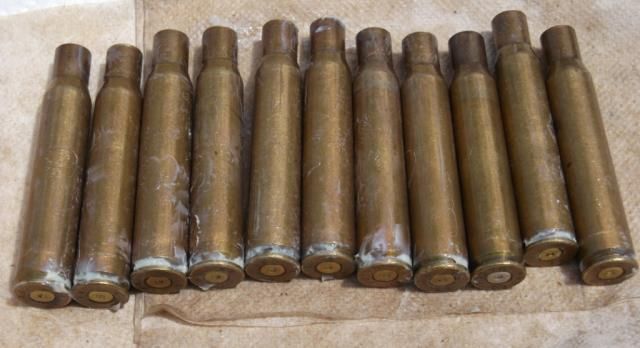
Grease is squeezed into the action areas making for a very messy rifle.

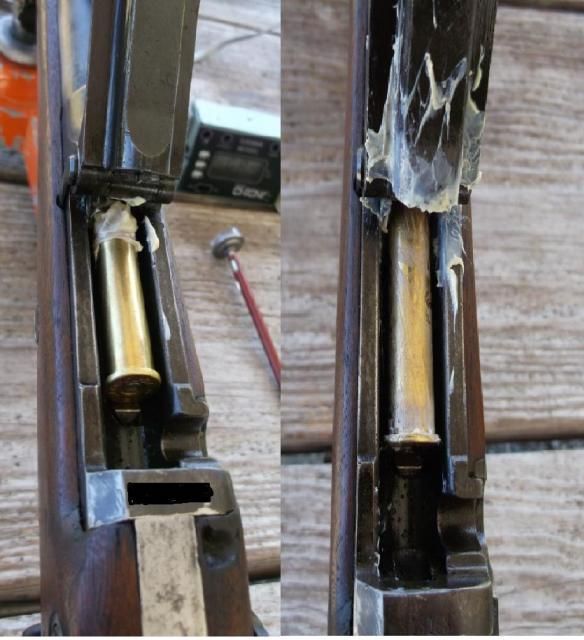
I pictured this same phenomena with my 1873 Trapdoor. Here are 45/70 cases heavily greased after dipping and twisting.
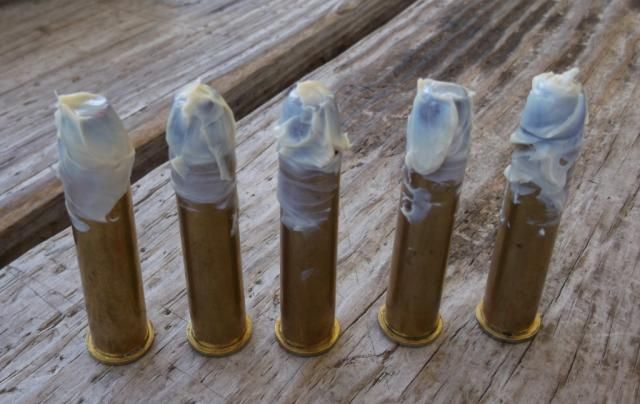
The first cartridge to be fired is in the left picture, and a greased, fired case is in the right. Notice how much grease is in the action after a number of these heavily greased rounds have been fired.
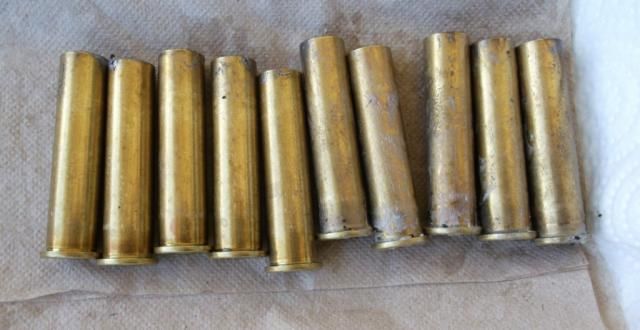
A tray of fired, ungreased 45-70’s on right, greased fired 45-70 on left.
Ungreased on left, greased on right
For several decades, I have been skeptical of Hatcher’s/Army claims of combustion pressure increases due to greased bullets, greased cases. Since 2013, I have been able to review the popular press articles, written by the Army, from 1920/1921 on grease and articles in previous years. I am convinced the Army had been misdirecting the iproblems of structurally weak 03 receivers, along with poorly made US Army ammunition, onto grease. This all came to a head in 1920/21 when the Army, having thought it had a fix for cupro-nickel fouling, decided to eliminate greased bullets to eliminate dirt scratches on loaner rifles. However, the tin can ammunition was a total failure, because the bullet cold soldered itself to the case neck, creating a serious and dangerous bore obstruction. The Army blamed the grease and never acknowledged it was the tin, or the rifles. Based on the information I have found, and the tests I have made, it is so surprising that in 1947, Hatcher is repeating junk science from a 1921 cover up. It is also so surprising, that the American shooting community unreservedly accepts Hatcher’s account.
If you read his chapter on Gun Corrosion, in which is the Tin Can ammunition experience, there are two points on which I strongly disagree. It has to do with the practice of greasing bullets to prevent cupro nickel jacket fouling and pressures. Hatcher states that “1, Grease increased the bolt thrust dangerously; and, 2, as if that weren’t enough, grease increased the chamber pressure dangerously”
His, or should I say the Army’s explanation for the second point, is that grease in the chamber pinches the case neck and thus prevents expansion of the case neck, thus dangerously raising pressures.
I decided to test this to see if greasing bullets would “dangerously” increase pressures. To do this, I decided to shoot heavily greased bullets, chronograph and photograph the before and after results. I used a load which literally millions of rounds were fired in competition: a 168 Match, 47.0 grains IMR 4895, LC cases.
These rounds were fired as sighting shots, to zero rifle. Bullets and chamber absolutely free from grease.
30-06 M98 Match Rifle 26" 1-10 Wilson Barrel
Code:
[SIZE="3"][B]168 gr Nosler Match 47.0 IMR 4895 thrown lot L7926 LC53 WLR (brass) OAL 3.30"

13 Aug 2014  T =  80  °F

Ave Vel =2619	2640
Std Dev =29		2618
ES =	72		2572
High =2644		2622
Low =	2572		2644
N =	5	[/B][/SIZE]
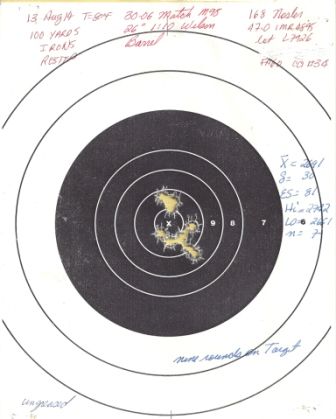
Code:
[SIZE="3"][b]168 gr Nosler Match 47.0 IMR 4895 thrown lot L7926 FA60 CCI #34 OAL 3.30"

grease in chamber from greased rounds

13 Aug 2014  T =  80  °F

Ave Vel =2691	2662	2672
Std Dev =30	      2698	2742
ES =	81		2661
High =2742		2718
Low =	2661		2687
N =	7

Group Size:  9 rounds on target. 89-4X on MR 31 target

 [/b][/SIZE]

Greased bullets before and after firing

Initial rounds gave spurious reading across the chronograph, of which I wish they could have been true, for my chronograph was providing readings of 3000 fps. Velocities this high would be incredible for this load and bullet. If it had been real, and without pressure signs, the next thing I would have done was test the combination at long range. If the accuracy stayed excellent, if I could get 400 fps more velocity just by greasing the bullet, it would have been my secret. But I suspected instrumentation error and that is what it turned out to be. I moved the chronograph two feet + further from the muzzle and continued with my testing. On previous shooting sessions , when the chronograph was too close to the muzzle, or shooting magnum cartridges, or black powder, gunpowder residue crossed over the screens and created physically impossible velocity readings or displays of “err1”. As an example, I had to move my chronograph out to around 20 -25 yards to get any black powder musket velocities. The amount of powder residue blown out of the musket caused instrumentation error. For this test, I believe a mass of grease, or grease plume, created sensor error. This is why the number of shots on the targets do not correspond with the numbers in the chronograph data.
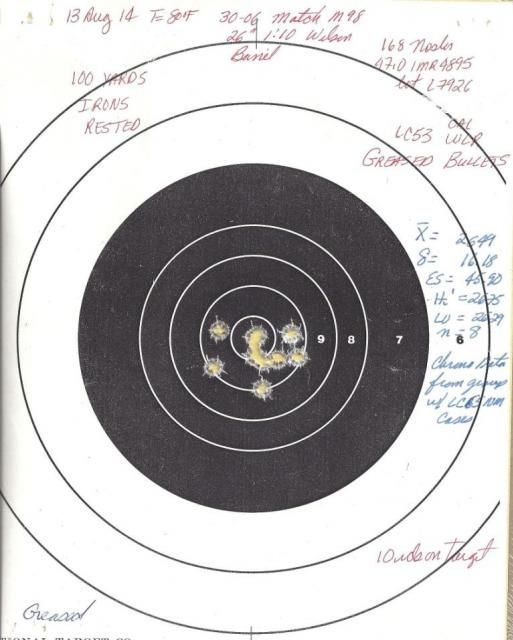
Code:
[SIZE="3"][b]168 gr Nosler Match 47.0 IMR 4895 thrown lot L7926 FA/LC cases WLR (brass) OAL 3.30"

Greased to case shoulders by dip and twist with Lubriplate AA130

13 Aug 2014  T =  80  °F

Ave Vel =2650	2658	2675
Std Dev =16		2669	2642
ES =	46		2636	2629
High =2675		2642
Low =	2629		2645
N =	8

Shot #5: grease beyond case shoulder, Shot #8 very heavily greased, [/b][/SIZE]

Shot #8, “Big Grease” before and after firing

At 100 yards I am of the opinion that the grease on the bullets did not cause any difference in accuracy or velocity and I did not observe any pressure indications.
Hatcher repeated an Army theory that greased bullets “dangerously” raised pressures because grease is incompressible, and that grease around the case neck “pinched” the case neck. This claim was made prior to the 1921 National Matches. While higher pressures should always give higher velocities, given that PV = nRT, pressure increases due to a thin grease layer do not follow a power law unless the volume is decreased exponentially. Without pressure measuring capabilities the only means I have of estimating pressure are inferences created after reviewing velocities, primer indications, (blown, leaking, primers, expanded primer pockets), and sticky bolt lift. I encountered none of these in any of my testing. It is possible that had I plugged the bore with grease, creating a bore obstruction, I would have experienced high pressure indications, but even so, given the huge mass of Lubriplate AA130 I put on the cartridges, if the Army’s claims were true about bullet pinching, I should have replicated the pressure problems. But I did not and I never have. This is not the first time I have shot greased cases, just the first time I have photographed greased cases, and it is the first time I have chronographed greased bullets. If, as the Army claimed, the case necks were prevented from expanding I should be able to measure this. I have measured the diameter of case necks, after firing with grease coatings, and the differences in diameter between dry and greased is within my measuring capabilities. I can’t measure a difference.
Primers of fired, greased rounds. Primers are rounded and show no evidence of pressure indications.

I would expect slightly higher velocities for the greased bullets, because ammunition technicians told me that in their laboratories they measured higher velocities at the same pressures for moly bullets. But given the small sample size in my shot strings, I can’t prove that one way or another. I look at the slight differences in velocities that I had for dry chamber, slightly greasy chamber, and greased chamber, as being all within the three sigma limits of what I would expect for that cartridge with that charge. That is, I don’t believe there is any significant velocity difference between any of my data strings, even though there are differences in the averages, but those are what you would normally see in velocity/pressure variations within the total population. So, based on velocities, I don’t see any evidence that grease on the case neck “pinches” the bullet.
What is totally wrong about the Army theory on “pinching” is the assumption that grease is immovable. Grease may be incompressible, but it is certainly not immovable. Under pressure, grease will flow. If it did not wheel bearings would have trouble rotating. With small arms cartridges the grease will flow because of the differences in metal thickness from the front and back of the case. Cases are thin at the front and thicken towards the back. The whole combustion event is faster than human perception, thus it seems instantaneous, but it is not. Combustion pressures take a finite amount of time to climb to maximum pressure. It can be assumed at each moment in time, the pressure within the whole case is the same, but of course, as time increases, the pressures increase. As pressures increase, the thinner parts of the case expand first, and as pressures increase more, the thicker sections expand last. This has the effect of squeezing the grease, some into the throat, and some out the action. I tried measuring the OD of the case mouths, to measure film thickness, and the layer is so thin, I can’t measure a significant difference with my measuring equipment. Between dry and lubricated cases, the case mouth expansion measurements are indistinguishable.
As can be seen in these pictures, the huge excesses of grease that I applied are squeezed out back of the case, filling the extractor groove in the process.

Grease is squeezed into the action areas making for a very messy rifle.

I pictured this same phenomena with my 1873 Trapdoor. Here are 45/70 cases heavily greased after dipping and twisting.

The first cartridge to be fired is in the left picture, and a greased, fired case is in the right. Notice how much grease is in the action after a number of these heavily greased rounds have been fired.

A tray of fired, ungreased 45-70’s on right, greased fired 45-70 on left.
Ungreased on left, greased on right

For several decades, I have been skeptical of Hatcher’s/Army claims of combustion pressure increases due to greased bullets, greased cases. Since 2013, I have been able to review the popular press articles, written by the Army, from 1920/1921 on grease and articles in previous years. I am convinced the Army had been misdirecting the iproblems of structurally weak 03 receivers, along with poorly made US Army ammunition, onto grease. This all came to a head in 1920/21 when the Army, having thought it had a fix for cupro-nickel fouling, decided to eliminate greased bullets to eliminate dirt scratches on loaner rifles. However, the tin can ammunition was a total failure, because the bullet cold soldered itself to the case neck, creating a serious and dangerous bore obstruction. The Army blamed the grease and never acknowledged it was the tin, or the rifles. Based on the information I have found, and the tests I have made, it is so surprising that in 1947, Hatcher is repeating junk science from a 1921 cover up. It is also so surprising, that the American shooting community unreservedly accepts Hatcher’s account.


 Now I develop my loads with lubed cases and I look for that primer transition and I look for hard bolt lift, and I am very sure when I see these signs I am at a max load.


Comment