
 Tweet
Tweet
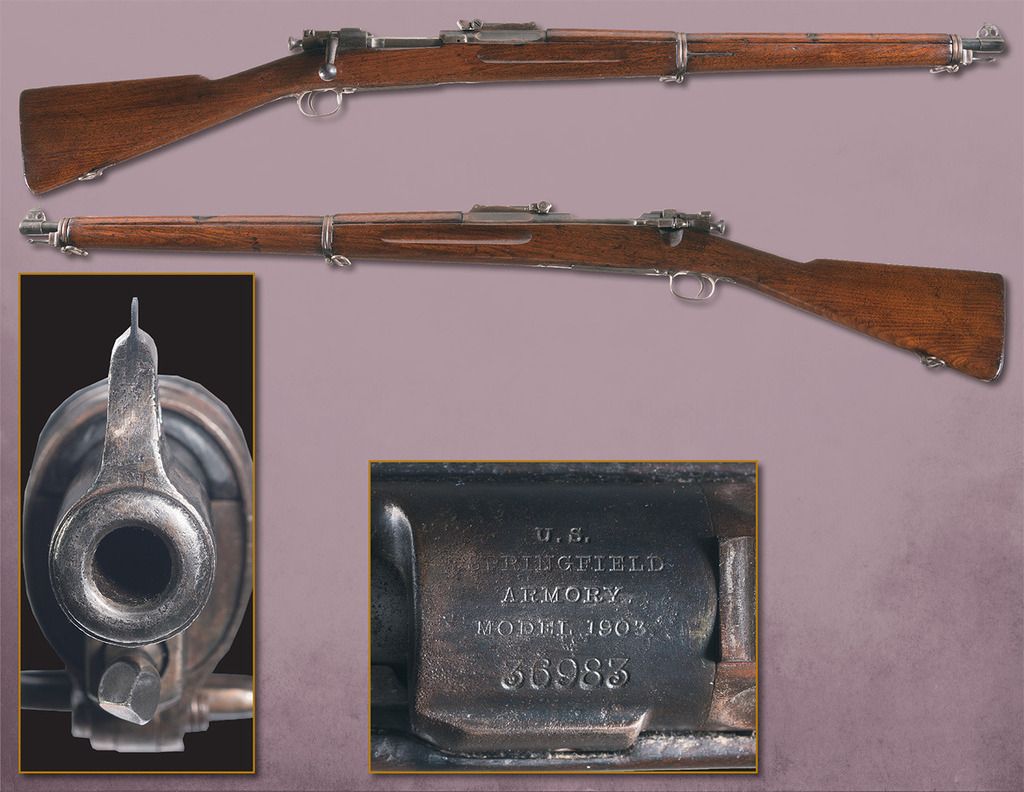
In April R.I.A. will auction a 1903 RB rifle. Looks really nice. Any guess what will be final bid? Go to their website to look. www.rockislandauction.com
-
-
Nice rifle. I've no idea what it might go for. However I've noticed that it appears not to have a Rod Bayonet stacking swivel.
Look at the photo of the one being sold and then look at the swivel on another with the correct Rod Bayonet configuration. There should be a flat on one side of the swivel stud or screw hole. The one in the photo of the rifle to be auctioned seems to not have this feature.
So, several updates happened along the way while these rifles were out there before they started going back to be altered. That alteration continued for most of the first decade of the 20th Century. An interesting observation. It's probably legitimate and the rifle appears to be the real deal.
The rifle appears to have an original rear sight in that it seems to be one piece and not made of two pieces. Those are tough or impossible to get if they aren't already on a rifle.
If anybody has one they'd like to sell me, I'll pay them whatever they want for it. Honest Injun.
Here are close up photo's of the area on my rifle for comparison...
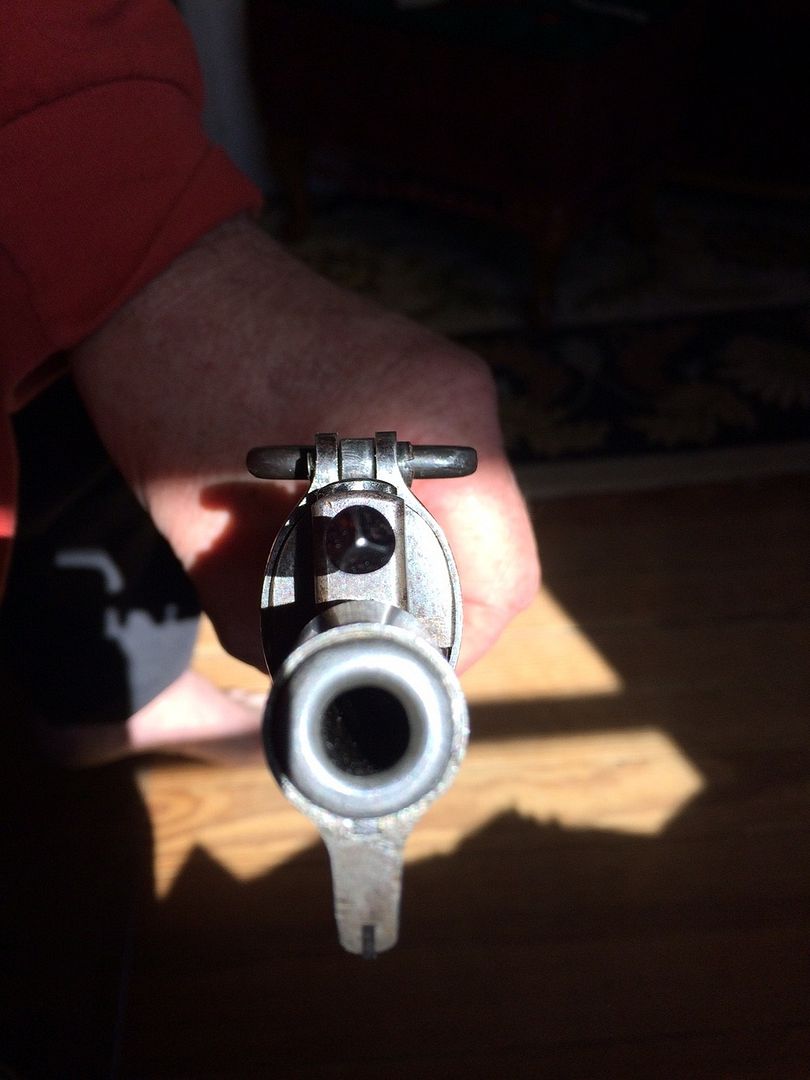
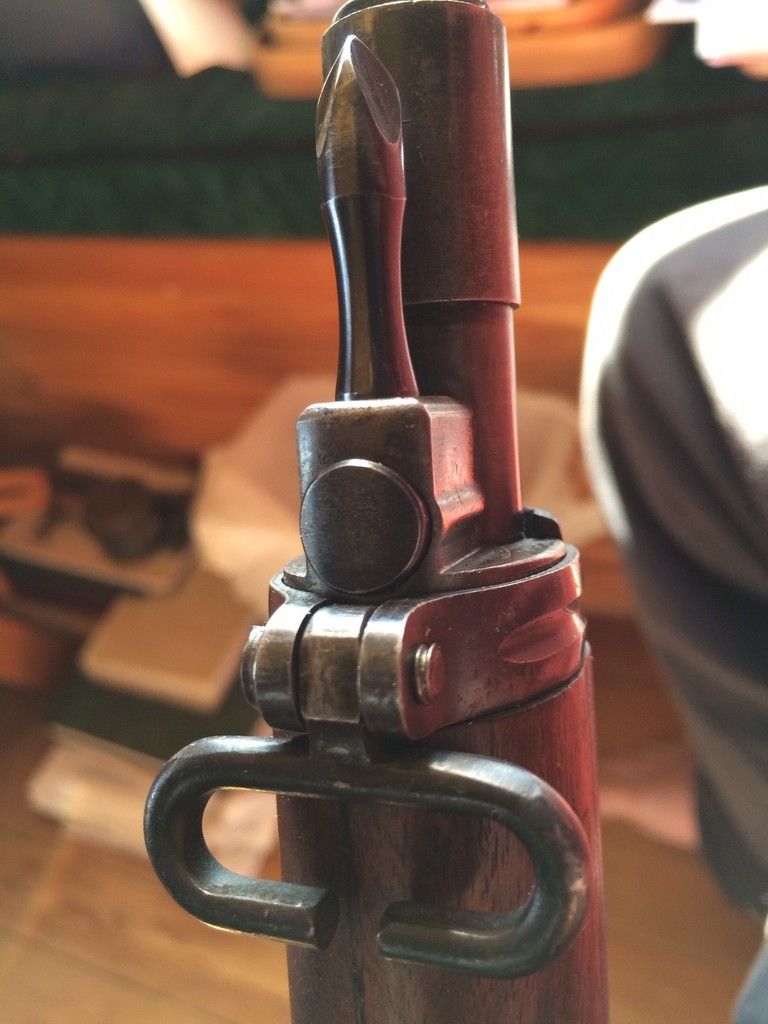 Last edited by Fred; 03-20-2015, 06:18.
 -
The Rock Island Auction rifle looks like a restored dug relic. For what it's worth.
Fred, what does the flat on the stacking swivel do? I don't own a rod bayonet rifle and I've never been able to figure that out. Please advise.
Thanks!
J.B.Comment
-
John, as near as I can figure out, when dismounting the front band, the bayonet release button was found to be in the way. Unless the front band swivel screw and swivel were completely removed, the band couldn't come off or on. Of course it was known that a soldier will eventually loose a small part if it doesn't stay attached to the rifle. So, they took a little off of one side of the stacking swivel to allow it to clear the button. the binding screw only needed to be loosened and so soldiers didn't loose the screws. The stacking swivel seems to be designed to be rotated to the "up" position to facilitate its passing over the bayonet release button IF the button were depressed all the way at the same time.Last edited by Fred; 03-13-2015, 05:31.Comment
-
Being LUCKY to be able to finally study this type of rifle, I've discovered something else that I'd wondered about these rifles for years. I've wondered what keeps the front band from coming off when the rifle recoils. Well, on what looks like the ears of the bayonet release button Housing through which the bayonet slides, there is a slight flare or mushrooming on its outer edge that catches the front edge of the front band IF and as long as the front band is completely secured by tightening the stacking swivel screw snuggly, thus pulling the band tightly behind the catching shoulders..Last edited by Fred; 03-13-2015, 04:07.Comment
-
I was of the belief that Rock Island never produced a rod bayonet rifle for issue. I believe I have read/heard that they may have produced one for whatever reason, but not for general issue. Is this correct?
Also, as an aside, a book by a well known author on the 1903 Springfield has as his representation of the rod bayonet rifle a parts gun as evidenced by the incorrect, later trigger guard. Notice the trigger guard on this Rock Island. The real rod bayonet had a very distinctive shape to the trigger guard with the long sides being parallel. The later trigger guards are more rounded as on the RI rifle.Comment
-
Trigger guard shape difference? Show us some photographs please of what you're describing.
Rod Bayonet trigger guards and later trigger guards should be the same except for the size of the slot for the trigger. I'd be interested in seeing a difference in shape.
The trigger guard on my rifle for instance is definitely a Rod Bayonet trigger guard as is evidenced by the longer trigger slot and the cross pin that was inserted through it to dis allow the trigger enough forward movement in the slot to release the sear of the cocking piece. Other than the length of the trigger slot and the presence of the pin, I cannot discern any difference in shape between the trigger guards on my later 03's and on my Rod Bayonet 03.Last edited by Fred; 03-14-2015, 07:50.Comment
-
Rock Island Arsenal produced a very small quantity of rod bayonet rifles, perhaps less than 100. None were issued and only one survives, and it resides in the Rock Island Arsenal museum.
Like Fred, I have noticed no difference in rod bayonet trigger guards other than the trigger slot that Fred described.
J.B.Comment
-
I have only seen 5 or 6 rod bayonet rifles that I thought were real. On the rifles that were correct the trigger guard had a very distinct shape. I also found this TG on a later rifle that appeared to be a rebuild. My RB 1903 in numbered 57294 and has this trigger guard (as well as the front stacking swivel with the machined flat). I have photos I can send to someone but I have not yet mastered posting photos here. The photo shows the RB 1903 above with the later 1903 trigger guard below.Comment
-
-
-
-
The longer trigger guard must be intended for a double trigger set up as on a set trigger?Last edited by Fred; 03-15-2015, 06:37.Comment


Comment