

 Tweet
Tweet
Several years back on one of the forums there was a picture of a low number receiver that had been drilled and tapped. The receiver cracked through the screw holes when fired.
-
-
I love this question. Just when does the public become aware of the problems with the low number receivers? I have gone through every Arms and the Man, from 1906 till the publication became the American Rifleman, and I have gone through every American Rifleman prior to WW2, and I don’t find a explicit warning about low number receivers. We know that as a population, they were so variable and inconsistent in strength and properties, that a 1927 Army review board recommended scrapping all of them. But who has the review board report and when was it put into the public domain? What I find in the public domain, prior to WW2, are offers by the Army to exchange low number receivers for new improved receivers. The explanation given was that the old heat treatment was not as good as what was done on later receivers. The offers are sort of like the new and improved soap ads you see. Nothing really wrong with the old soap, but this new soap is so much better, you have got to have it. There is nothing in the public domain about burnt, defective, dangerous receivers blowing up in your face, removing half of your face, all of your eyeballs, and a part of your hand. Maybe the Army preferred not to mention that they had spent about $1. Billion dollars making 1.0 Million defective and dangerous rifles.Wouldn't there be a good cause to politically blow up this issue before the public in the WWI post war years? Typically during peacetime, especially following a war the military sees a significant reduction in funding for their budget due to the need the threat of war has been removed.
If you want to maintain your war production capabilities and justify funding in the post war peacetime era, how do you justify it to the Congressmen and Senators? You create a problem, crisis that needs immediate attention....
You need to completely revamp the whole production process which is going to require tooling, personnel, training and most importantly a non-stripped budget. So that way you don't lose your factory and workers.
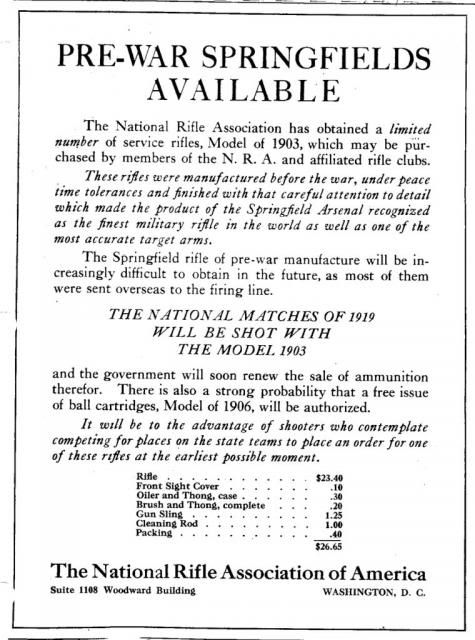
This is an ad from 1919 . Pre War, that is WW1 rifles, are just the pink. Better get one while you can:
After reading this, I want to run out and watch that FIFA Movie: United Passions and cheer for the incorruptible FIFA Management. The movie tells us, they are not in it for the money, they are in it because of their passion for football.
I have read Crossman, Sharpe, and others, and it is clear to me, all they know is heat treatment. They carp about heat treatment this and heat treatment that, but they are totally clueless as to the real problem in the Arsenals: lack of temperature instrumentation. Every time a metal part is exposed to heat, there is no temperature gage. This is medieval process controls: people eyeballing temperatures. The single heat treatment as practiced by Springfield Armory was just a heat and a quench, which is actually a very poor heat treatment. Even period books, my first edition Machinery’s Handbook shows they should have done a heat, quench, and temper, but even then, the single heat treatment should not have produced receivers were dangerous to use. The material properties were not great, but they should not have been dangerous. I suspect the knowledge that 1 million rifles were assembled without temperature gauges and therefore a large population of them ended up burnt, was not only kept out of the public domain, but kept within the Ordnance Department. I really doubt the guys at the top knew about the problems they had within the Arsenal System, and no one wanted to know. The Army has an unjust culture and a history of shooting the messenger.
Not only is no one in the Army Ordnance Corp acknowledging that they had made 1 million structurally deficient rifles, when a single heat treat 03 blew, the Army claimed the blowups were due to the user practice of greasing bullets. This is and was a lie, greased bullets do not “dangerously” raise pressures, unless of course, you are shooting a structurally deficient rifle. The Army published an editorial in the Arms in the Man, in 1918, claiming that 03 rifles blew up at no higher rate than any other rifle and that when one blew it was all due to shooter misconduct.
What occurred in 1927 to cause an Army Board to look at this issue, I don’t know. But lets say you are Springfield Armory, the new advanced rifle is a decade or more in the future, and your teeny tiny post WW1 workforce really has nothing to do, and it likely to be sent home, maybe that is where the problem surfaced. Until you study the attitudes of the late 20’s you don’t realize just how little people wanted war, how much the military was suspect, and how little support there was on Capitol Hill for more military spending.
I once looked at the number of men in the US Army just after WW1, the drawdown was severe. There were approximately 3.7 men in the Army in 1918. By 1919, there were 19,000 Officers and 205,000 enlisted. By 1921 there were 12,000 Officers and 175,000 enlisted. Someone else can search but I believe by 1927, there were even less Officers and Enlisted as Congress was not interested in funding the military. There were a lot more rifles in storage than there were men who needed rifles.
I am of the opinion that the single heat treat issue was finally raised in the late 20’s, and by Springfield Armory. I have no proof, but by the late 20’s I do not see a military need for more 03’s. There were 2.5 million M1917’s in storage, future production of a semi automatic replacement was years, if not decades off, and considering the ideas of “endless prosperity” and the “war to end all wars” attitudes of the times, I believe Springfield Armory was under the threat of a real shut down. An order for 1,000,000 new 03’s would have been just the ticket. As it was, we know an independent board was established, and it makes sense, because if this was started by SA, any investigation would have had to have been taken out of their hands, given that they would have had a financial incentive in the matter. So this is my pie in the sky conspiracy. Springfield Armory was perfectly placed, as they had all the data, to make a case that all low number rifles should be scrapped, and replaced with new rifles.
Instead, it did not happen that way. Instead of a nice big order for one million rifles, Springfield Armory gets to make replacements when defective rifles blow, or are returned, worn out, to depot. Wonderful product recall, just keep the defective product in service until it hurts someone, or is worn out. It is the low cost alternative, and in my opinion, immoral. Those who support it, are also immoral. Those who support the immoral decision makers who made the decision, are either immoral, or out of touch with reality. Maybe both. And we did not find out about any of this until Hatcher’s Notebook came out in 1948.
So, again, just when does the public become aware of the real problems with the low number receivers? I contend, in 1948, and not before then.Last edited by slamfire; 06-18-2015, 02:02.Comment
-
Great Post!Comment
-
Great Post!
Thanks! I am however putting on my rain coat as I am about to get pissed on by the multitude of romantics who worship the Ordnance Department, Springfield Armory, and its products. These guys have an Shiny City on the Hill image in their head,

and anyone slinging mud at their Utopia is going to get it!
 Last edited by slamfire; 06-18-2015, 12:07.
Comment
-
My question always was, if they were so dangerous, why did they rebarrel them during WWII ?Last edited by M1CHAZZ; 06-18-2015, 12:55.Comment
-
At the time, who knew how dangerous low number receivers were? I keep on asking that question and am earnest in desiring to know just when did the Army Ordnance Bureau make a full, open, and honest account of the problems with low number receivers? I don't think the Ordnance Department ever did, but portions of the 1927 report must have leaked out, but not enough to convince ideologues, such a Edward Crossman, that there was problem with low number receivers. Just read Crossman's Book of the Springfield. Crossman uses distasteful racial images in arguing that low number receivers are perfectly safe. By introducing those images, and given that he was considered an big, big, big, authority figure
 at the time, anyone who had a blown low number receiver would have been considered by the shooting community as one of those distasteful racial stereotypes. Certainly not a lot of introspection here. The basic failure is the Army's: The Army's unjust culture and the Army's institutional failure to address problems within its Ordnance Department.
When reputations are at stake, High Level Officials do their darndest to muffle and misdirect blame. Might was well ask why the Navy kept the Mark 14 torpedo in service for as long as it did? The Bureau Naval Ordnance absolutely refused to admit they had a torpedo problem. Good Americans died because of their defective torpedoes and Bureau Naval Ordnance never once apologized, admitted it lied, instead it muffled and misdirected problems away from itself. The primary reason was the guys who were in charge of the M14 torpedo program, got promoted up, and from their High Level perches put the blame on anyone but themselves. http://www.defensemedianetwork.com/s...u-of-ordnance/ and https://en.wikipedia.org/?title=Mark_14_torpedo These guys would rather had America lose the war, then admit to their failures.
There is no reason to believe that the Army Ordnance Department with its low number receivers would have acted any different.Last edited by slamfire; 06-18-2015, 04:27.Comment
-
More than a little bit of 'presentism' in ascribing motives without evidence. The world was a different place and risk was looked at differently than today.
On the date the decision to keep the low numbers was made, those in charge had never driven a car with a safety glass windshield, had never worn a seatbelt, had never seen a construction project where the workers wore hardhats, and had never slept in a house with a smoke detector.
My guess is that science hadn't yet developed the acid etch test whereby burnt steel could be positively identified. It's possibly hinted at in a description of the postwar testing of the inventory of barrel blanks, but it's a bit ambiguous.
For someone with a deep interest, SA's FY28 Annual Report listing "Report of an Investigation of the Strength of Receivers for the Cal. .30, M1903 Rifle" could prove useful. With that description, NARA should be able to locate it. All it takes is an email request, a lot of patience, and, dependent on the report's length, a few bucks. Of course, internet speculation (mine included) is free.Comment
-
Well, I fired a lot of rounds of cheap World War II surplus .30-06 G.I. ammo in a Low Number Rock Island '03 a friend of mine gave me in the 1960's.
Didn't even know anything bout how dangerous Low Number '03 rifles were. But the receiver of mine must have been forged on a day when the sun shone and the smith pulled the receiver out of the furnace before the steel became burnt.
That being said, I would not fire a Low Number '03 nowadays. I am too old and too wise.Comment
-
I have one comment with respect to slamfire's discourse. If I interpret his words correctly, he lays the blame for stirring up the low number controversy squarely at the feet of Springfield Armory. This was not the case. While Springfield Armory did indeed have a strong vested interest in the outcome of the debate, Army Ordnance at the highest levels had inserted themselves into the controversy. But one must recognize that many Ordnance officers in Washington had served at Springfield Armory. So they were looking out for their buddies left behind in Massachusetts.
J.B.Comment
-
A cousin of mine was drafted into the army in World War II and sent to Fort Stewart, Georgia for training.
He told me that they were issued Model of 1917 Enfields (in 1943) and one or two blew up on the range when the G.I.'s were qualifying.
Yet, no one ever hears anything about "defective: M1917 Enfields, or somne of them blowing up. I do wonder why.Comment
-
I am of the opinion that the same problems that the Government Arsenals had, so did some of the manufacturer’s of P17’s. That is, forge shop workers paid piece rate with little to no oversight, and/or little to no temperature instrumentation used in production. I read a post from a gentleman who claimed to have met an Eddystone Forge shop worker. They were paid piece rate and by cranking up forge temperatures, the forge shop workers were able to stamp out parts faster. The factory therefore had created a perverse incentive by paying workers piece rate. The phenomena of burnt steel components was well known back then. The topic is in my 1914 first edition Machinery’s Handbook.
I have heard a number of accounts of brittle Eddystone receivers, from P.O Ackley blow up tests, to others. I have talked to gunsmiths who cracked Eddystone receivers removing barrel which indicates to me a metallurgical problem.
Unlike low number Springfields, the M1917 does not have a published failure database. I don’t believe the Army wanted to create one nor would they have wanted to. The Army wanted to withdraw the M1917’s as soon as possible and have the battle memory of the rifle also disappear as quickly as possible. I have read the Arms and the Man of the period and it turns out the M1917 was an excellent battle rifle. Its features totally overcame any initial skepticism about the rifle. There were more 1917's than 03’s even though they were only made from 1917 to 1918. The 03 Springfield was made up to 1939. It is my opinion that as long as the Winchester, Remington factories were viable, the Army did not any attention drawn to the M1917. If an adult had been in charge, a serious look at the 03 rifle might have permanently shut down the 03 production lines. But this would have effected Government budgets and Government Arsenals. It is historical fiction as to what might have happened, but at the end of WW1 there were at least 1,000,000 03’s of suspect quality, the M1917 was the issue rifle for the vast majority of Americans in Europe, the Army was familiar with the rifle, the 03 was an inferior battle rifle to the M1917, and there were a lot more M1917’s around than there was 03’s. Any attempt to quantify the number of defective M1917’s might have raised questions about the number of defective 03’s if anyone outside the Ordnance Department knew there were any. I don't think anyone of importance did. No one has found any contemporary history or analysis on defective M1917’s. What is in history books is the procurement history, from a British design to an American service rifle. M1917 books retell the same procurement history and copy data from issue service manuals. Beyond this, in the public domain there is very little new or value added information about the M1917. The rifles were made at commercial concerns, whatever records were tossed in the trash a long time ago. However, General Hatcher had personnel experience with the failures of low number Springfields, he was there at the very beginning, had all the reports, and he never provided a peep about burnt receivers prior to his retirement. Once he had retired, and the 03 Springfield was out of service, then and only then did he divulge the big picture. And because of that, we definitively know that low number 03’s are risky, that they are made out of inferior plain carbon steels, and that they were produced on production lines that did not have temperature instrumentation whenever heat was applied.Last edited by slamfire; 06-27-2015, 02:15.Comment


Comment