-
-
-
The head I f the Krag cartridge is fully enclosed by the chamber when the bolt is closed. A case head separation is not a big deal in a Krag or an Enfield. In a Mauser based action, the rear portion of the case is unsupported. A case head separation will allow high pressure gas back into the receiver. The SHT design of the Krag did indeed cause issues in a different manner - cracked bolt lugs when the Army attempted to adopt the 2200 fps cartridge. Some rifles performed just fine while others developed cracks in the front lug.Comment
-
The head of the Krag cartridge is fully enclosed by the chamber when the bolt is closed. A case head separation is not a big deal in a Krag or an Enfield. In a Mauser based action, the rear portion of the case is unsupported. A case head separation will allow high pressure gas back into the receiver. The SHT design of the Krag did indeed cause issues in a different manner - cracked bolt lugs when the Army attempted to adopt the 2200 fps cartridge. Some rifles performed just fine while others developed cracks in the front lug.Comment
-
Can't speak for the load used by the SHT failure. Can say have fired a wheel barrow load or two... three of cast lead handloaded ammunition in 03 and 03-A3 rifles since 1980. Have used routine care in loading. Have not ever had a single issue. The same is true of my loads using jacketed bullets. The bullet is not problematic if it is appropriate to the rifle being used. Do doubt that merely having a well fitted Lyman #2 alloy bullet fully engraved when chambered was the direct cause of the failure. Do consider the strong possibility of a error in charging the case, either a double-charge. Once upon a time was loading .45 ACP. Had one round report louder on firing. No other problems. Case primer showed more pressure than normal. Load used was a mild mid-range target load w/ 200 gr. H&G 68 bullet. If using a low charge weight pistol powder, entirely possible to inadvertently make an error if checking after charging is not rigorous.
AFAIK, there is no one winning at any significant level of benchrest competition using anything but hand loaded ammunition. I have fired a lot of pistol matches. Lots of fellows use the 9mm b/c is it cheap. They shoot factory ammo and do fine. But, the fellows who shoot enough to be at the top are shooting hand loads... or they are factory sponsored.
All of the early receivers were less than ideal for handling gas. All of them were heat treated under less than ideal conditions compared to later techniques. The beautiful Swedish 96's are not any better than the 93's, etc. They reflect the realities of the era in which they were developed. The 03 was a derivative of the Spanish 7mm Mauser. It was designed to produce excellent feeding... thus the coned breech that so many folks opine in problematic. The later Win. M-54 and then M-70 used that exact same coned breech. Their success was due to improvements in heat treating as well as venting. The original 03 method of using a little gas vent in the right locking lug ... through the extractor... through the right receiver ring was not good. The Hatcher hole was a very good retrofit. Ideally milling the bolt ala the Mauser 98 would have been extremely helpful. JMHO. Sincerely. bruce." Unlike most conservatives, libs have no problem exploiting dead children and dancing on their graves."Comment
-
Last year on this Forum, when there was considerable discussion of Hatcher, LN 1903 Springfield failures, and single heat treat / 'burnt steel' problems, '5MadFarmers' shared period metallurgy findings (War Department Document 901) that showed the steel alloy on some failed rifles was out of specifications.
(IIRC - excessive levels of Phosphorus and Sulfur in the steel alloy, which compromised the strength and elasticity of some LN receivers).Last edited by butlersrangers; 06-12-2016, 08:14.Comment
-
I have done a considerable amount of reloading over the years and make it a point to consult several sources when working up new loads or using new to me powders and bullet combinations.
That said, something bothers me that maybe others can clarify. Accurate's online tables for 5744 and the 30-06 shows the following:
REDUCED LOADS-NO OTHER LOADS RECOMMENDED
200 grain Lyman #31129. 22 gr
210 gr bullet is not listed, but that being the case, shouldn't it be a loading of 18-20 gr?
How do you reconcile the difference in Accurate's factory website and Lyman's 49th? Seeing the loads others have posted it would seem Lyman is wrong.
Any ideas?Last edited by Texraid; 06-13-2016, 11:26.Comment
-
Texraid, I too now question the Lyman data. Here is the relevant page of that manual. Note the differences in max load pressures among the various powders listed for this bullet, but more importantly, look at the differences in minimum loads for this powder using this bullet in comparison to the same powder and the minimum loading for the 311299 bullet (upper right table).

Comment
-
Looks like something very fishy in that data! Why would a 195 gr bullet start at 23 grains, a 200 gr bullet start at 21 grains... and then a 210 gr bullet jump to a whopping 28 grains?"I was home... What happened? What the Hell Happened?" - MM1 Jacob Holman, USS San PabloComment
-
Although I'm certainly no expert when it comes to bullet design and variances... I'm fairly sure that powder charge is based on bullet weight, so I believe that a 210 grain bullet is 210 grains, be it a Hornady, Nosler, Sierra... etc. The same should go for cast also, whether it's a Lyman, LEE, NOE, etc. 28 grains is one hell of a jump from 21, and (again, I'm not any kind of expert here) as far as I know, powder charges generally go down as bullet weight goes up. If I'm wrong about that, please let me know..."I was home... What happened? What the Hell Happened?" - MM1 Jacob Holman, USS San PabloComment
-
You are not wrong. Even if I/you are wrong, I can't fathom a 36% increase! That would be based on 18gr. IF that is correct.
I can't help but wonder if Lyman intended to print 18 instead of 28??? That would certainly be more in line for a starting load and would logically follow Accurate's factory load data.
ArtLast edited by Texraid; 06-13-2016, 03:21.Comment
-
Texraid,
Your habit of checking multiple sources is obviously a REALLY GOOD IDEA in hindsight. I don't know many sources that publish data for very many cast lead bullets, but clearly I need to find another one, if I'm to play with modern rifles like this.Comment
-
This is just another example of why it is best practice not to shoot these old rifles with any load at all. They are as a class: unsafe.
The Army was an Infantry centric organization and the knuckle draggers did not understand nor did they want to understand production problems and they were certainly not interesting in spending money on their Arsenals. Instead of fighting this, and scuttling any chances of promotion, I believe the Colonels in charge of Springfield Arsenal spent their tour drinking mint juleps between chukkers on the parade ground in front of Springfield Arsenal. I have seen pictures of these guys doing just that. The Army did not want to hear bad news and instead created fallacious stories that absolved them of all fault and responsibility when their single heat treat receivers blew. Since most of these guns blew up in a period when shooters greased bullets, the Army created the story that greased bullets, greased chambers were the cause, because by the process of elimination, it had to be the grease. Their perfect rifles were blowing with their perfect ammunition, so it had to be the grease. This is still believed by the vast majority of the shooting community, the dominate posters on this forum, and it is all bunk. The problem with single heat treat receivers was a combination of an old, antiqued factory with old antiquated equipment, an illogical production flow, and an organizational attitude where the hierarchy only wanted to hear good things. Workers in such organizations learn quickly that the bearer of bad news is not welcome, and if such a person is too persistent, management terminates them.
There are a number of issues with all of the single heat treat 03's. Firstly, the problem was not the heat treatment. The single heat treatment would have produced a perfectly satisfactory receiver, (caveat: for the period) but Army was negligent in buying instrumentation for their factories. Instead of buying pyrometers, workers were required to judge steel temperature based on their eyeballs. Eyeballs cannot hold the temperature tolerances required for heat treatment of those steels. Basically the workers were using Medieval production methods because it was cheaper, and the Army priorities were not keeping their Arsenals up to date. I am of the opinion it was more than benign neglect, it was a matter of Corporate Culture. According Dr Deiter Storz's book: Rifle & Carbine 98: M98 Firearms of the German Army from 1898 to 1918 Amberg Arsenal installed pyrometers in 1906. The German Technical staff and Managers recognized the limitations of eyeballs in heat treatment, that is they thought about it, and decided to improve their production line to make good rifles.
As an example of the improvement in duty lifetime when production lines were organized logically, and instrument used to evaluate temperature, instead of eyeballs, I offer this is book review from Jan 1926 Transactions of the American Society for Steel Treating.
Making Springs for Motor Vehicles
Canadian Machinery, 12 Nov 1925, page 15
The author of this paper discusses the benefits that have come to the manufacture of springs in the motor car industry from metallurgical research. Springs today stand four or five times the work of those a few year ago because the “skill” and “guessing” of the forger has been replaced by heat treating furnaces with temperatures maintained at the proper degree by pyrometers. The Dowsley Spring and Axle Co., Chatham, Ont., a subsidiary of the Ontario Products Co., is taken as an example of a thoroughly modern plant, and its work discussed. There are 145 men employed in the plant and production averages about 55 tons of springs a day, a single spring weighing anywhere from 17 to 44 pounds.
The plant is so arranged that material follows a straight path from storage to shipping room. Until a few years ago all springs were heat treated in small oil-fired furnaces. Today this method had been discarded. A continuous heat treating, forming, and quenching process has been evolved, which is practically automatic and eliminates the human element. As an example of what careful- heat treatment has done toward prolonging the life of springs, the results of test of springs made by the hand method and those by the continuous heat treatment method are interesting. Some years ago 40,0000 deflections were about the average before failure, now 120,000 is a low figure.
You can see in this the early vacuum tube era (1925) that a changeover from eyeballs to temperature gauges has really improved the fatigue lifetime of springs.
If the receiver was burnt, that is over heated during forging, it cannot be fixed by heat treating. Burning steel is not like burning toast but anyone with brains has noticed you cannot stick burnt toast back in the toaster and heat it back to fresh. Once ruined, it is ruined. Burnt steel is a fusion reaction, fusing the steel into one big austenite crystal. The desired crystalline structure is martensitic. But when steel is raised to a “white hot” temperature the steel is all in the austineitic phase. When it cools from this temperature it is a very hard, brittle steel. I have been told by metallurgists the carbon is burnt out. It is impossible to anneal or heat treat burnt steel back to a useable material. Long anneals will break up some of the hard areas, but not all. To make the steel useable it would have to be completed melted and cast again, as it is came from the steel foundry.
The single heat treat cycle was
Receivers and bolts of SA, serial number 1 to 800,000
Material, Class C Steel
Treatment: Carburize in bone at 1500 F for 4 hours, then quench in oil
Another problem with single and double heat treat receivers is the low grade of the Class C and Class A materials used in single and double heat treat receivers. These materials are low strength and have a very low fatigue life compared to alloy steels. In every particular, these plain carbon steels are inferior to alloy steels. Watertown Arsenal was urging Springfield Armory to use 2340 instead of Class C steels prior to WW1, and the recommendations were ignored. Springfield Armory used this stuff primarily because it was cheap and the production engineers at Springfield Armory were familiar with the material. There is no justification for the continued use of these materials based on material properties. Today identical materials are used on rail road spikes and cheap rebar, because they are so low grade and cheap. No one in their right mind would use the same materials in a firearms application, unless they wanted to be sued. Plain carbon steels were commonly used on parts prior to WW2, but metallurgy in the 1920's and 30's advanced so quickly that by the time you get to WW2 it is obvious that plain carbon steels are only a good choice if cost is the number one criteria and the loads are not high or safety critical.
The American metallurgist Edgar Bain, http://www.nasonline.org/publication...in-edgar-c.pdf in 1932 published conclusive experiments on carbons steels. Bain heat treated identical plain carbon steel coupons under identical conditions and examined the coupons afterwards for hardness depth. The black chemical etching, which I assume is the unhardened steel, show that plain carbon steels have erratic hardening depths, given that all else is equal. These steels were called in WW2 era text books as “shallow hardening”. This was meant not as praise but as a pejorative. As is shown on the right of the diagram, the hardness of these coupons varies by depth. This is not good as consistent hardening provides consistent material properties. It is undesirable to create parts some of which will be hard through and through but others soft below the surface even though the heating processes are the same for all parts. But use plain carbon steels, and you will create such inconsistent parts, just by the nature of the material.
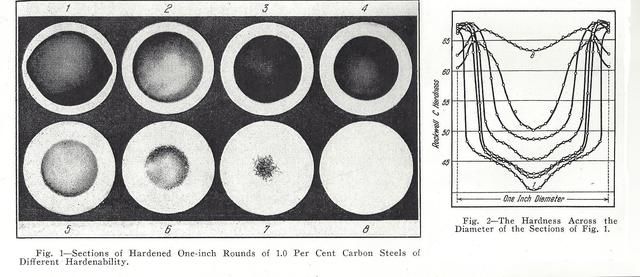
Therefore, you would expect even properly forged, properly heat treated single heat treat and double heat treat receivers to vary considerable in hardness depth, which then affects the properties of the end part.
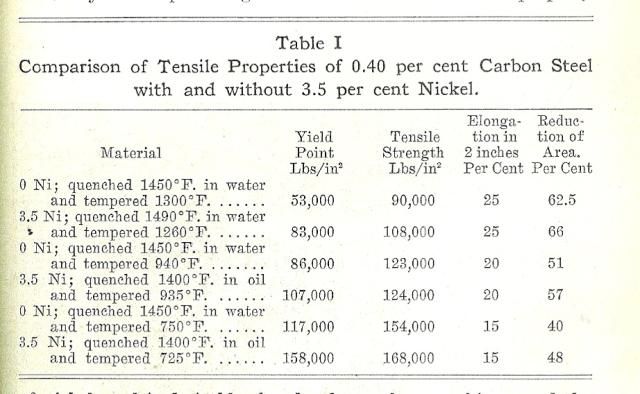
Yield is an extremely important material property, for above yield, the part deforms. Once a steel part yields it is no longer safe to use. What happens after yield is unpredictable, often it takes less load to cause more deformation, ultimate load is the load it takes to break the part. In this early 1920’s chart, for the same essential heat treatment, the nickel alloy steel always has a higher yield, a significantly higher yield in all cases, than the plain carbon steel.
Nickel steel versus plain carbon steel
What is not shown in these charts is a material property called toughness. For a device, such as a receiver, which is going to be subjected to impact loading, toughness is a highly desirable property. Toughness is directly related to fatigue lifetime, which is the number of loading cycles to failure. Assuming the yield is sufficient for the load, the tougher material will have a longer service life. Alloy steels have a greater toughness than plain carbon steels. Alloy steels take more energy to shear, Charpy impact tests are a direct predictor of a steel’s fatigue lifetime. It is a revelation to see just how shear energy decreases with temperature, and at low temperature, alloy steels take several times the energy to shear as do plain carbon steels.
Pryometric cones have been around since the 1800’s, but I have no idea if they were used at Springfield Arsenal or even in the steel mills of the period. I don’t know if anyone reading this understands vacuum tube technology, late vacuum tube technology was much better than early vacuum tube technology, and no vacuum tube technology meant process controls depended on sight, taste, touch, and smell. These early M1903’s are pre vacuum tube technology. Human sensory perceptions have their limits and processes governed by them are not going to be very exact or repeatable. You see this in every evaluation of the steels of the period. This is an excellent example of what I find when someone reports a technical analysis of WW1 era steels:
Rolling Block strenght
Therefore, old single heat treat receivers are a very significant unknown quantity. We know they were made in a factory that did not have temperature controls, we know that the material varies considerably in properties after heat treatment, and that the service life of the part will always be less to one made out of a good alloy steel. We also know the steels of the period were inferior in material properties to the exact same compositions made today, just due to the process controls of the period. Just how many service lives have these old receivers been though? How many more load cycles will they take before failure? How will they react in an overpressure situation?I did not know this until I looked as a response to your post. However, I have worked with Steel my entire professional career. I was the head of a Testing Lab in a steel manufacturing facility for 4+ years. During that time, I was provided a ferrule from a WW1 fighter airplane for testing. It was made from what was labeled "high strength steel" (the label was from WW1). I tested it and found that it was lower strength than the lowest strength steel that can be bought today. In addition, it had a lot more impurities than would be allowed today, particularly sulfer. (PS. "today" means from about 1975 to 1980). I know that steel has continued to increase since then in strength, ductility, and all the other desireable characteristics we use without thinking about it.
Therefore, regardless of the hoopla around double heat treat receivers, “old world craftsmanship”, or the romantic feelings and emotions of those who believe the past was a better place, these old plain carbon steels are inferior in all aspects to alloy steels. It is my opinion that a combination of false economy and just reluctance to change by the Chief Metallurgist is why Springfield Armory kept using plain carbon steels even when early in the 20th century, it was obvious that these steels were rapidly becoming obsolescent, and by the 1920’s, they were obsolete for this application.
So, based on the unpredictability of these low number receivers, you just don't know how long it will be till something breaks. There were so many accidents that in 1927 an Army board looked at these things, reheated samples and found that 33 1/3% would break in an overpressure condition. The board recommended scrapping all 1,000,000 of the rifles, but because it was the cheaper solution, the Army decided to keep the rifles in service. It was cheaper to injure a Soldier, Sailor, or Marine than to replace the $40.00 rifle that injured the man. I don't know your feeling about this, but I consider this evil and unethical behavior. Any service man refusing to shoot this rifle, because of fears it might break, would be subject to a court marshal, but this is a moot point: they were not informed anyway. The Army never really went out and told anyone that their rifles were defective, we did not know the true extent of the problem until the Springfields were out of service, and Hatcher published his Book: Hatcher's Notebook in 1947!
The more I study this issue, the more I am disturbed to read the narratives from people whom the shooting community considers to an authority figure. Dr Lyons is one, he is a low number Springfield fan and by his analysis he is promoting risky behavior.
Some Observations On The Failure Of U.S. Model 1903 Rifle Receivers
Dr Lyon’s risk analysis is solely based on the list in Hatcher’s Notebook. There are known low number blowups before Hatcher’s list starts, and there are known low number blowups after Hatcher’s database ends. Hatcher’s list is an incomplete list of low number accidents. It is really disturbing to realize that Dr Lyon is a medical Doctor (might be a reason 120,000 people die each year to medical mistakes) and to see that his analysis ignores underlying causes. Dr Lyon’s is not interested why these things break. His analysis is strictly on the numbers in a data base. For him, the characteristics of low number receivers are irrelevant. The technology of the era, the poor quality of the steel, the lack of process control technology, these are all ignored by Dr Lyon. It is as if low number failures have no assignable causes: the receivers just blow up randomly. No rime or reason to it, just acts of God, totally unknowable and unforeseeable. His statistics provide assurance to many that the risk of shooting a low number receiver is very small, but his analysis is very flawed . There are reasons beyond random chance why these receivers are structurally deficient.[/SIZE]Last edited by slamfire; 06-14-2016, 10:58.Comment

 Tweet
Tweet




Comment