Official Use of the Term "Enfield" for the M1917

Collapse
X
 
  • Time
  • Show
Clear All
new posts
  • dalbert
    Junior Member
    • Jul 2011
    • 15

    #1

    Official Use of the Term "Enfield" for the M1917

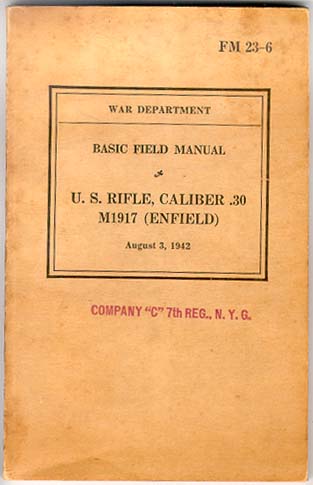
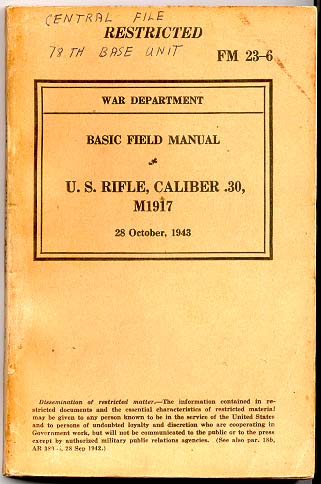
    I just want to clarify something that has been published about the M1917 Rifle, and that I have also heard while discussing the rifle at gun shows. This "something" is that the M1917 was never officially referred to as the "Enfield." This is incorrect. The term "Enfield" was a term often used by soldiers to describe the M1917 Rifle, and the August 3, 1942 edition of FM 23-6 for the M1917 Rifle is titled, "U.S. Rifle, Caliber .30 M1917 (Enfield)." I believe the ubiquitous nickname drove it to become referenced as such in one of the official WWII era War Department Field Manuals for the rifle.

    In my opinion, this is one of the many reasons that period paper items, such as FM's and TM's are such an important resource for any firearm. They demonstrate many facts from a moment in time that sometimes become blurred with age.

    Here is a photo of the manual, along with the later version that does not include the "Enfield" name.


    David Albert
    dalbert@sturmgewehr.com
  • older than dirt
    Senior Member
    • Nov 2010
    • 194

    #2
    I have always referd it as a 1917 Enfield ever since I first heard of one 60 some odd years ago because that`s what it was called.

    Comment

    • Col. Colt
      Senior Member
      • Jul 2010
      • 928

      #3
      It would be odder still if it was NOT referred to as an "Enfield". Except for being rechambered to .30-06, it's the same rifle, built in the same plants on the same machines!

      I've always found it odd that people would correct others insisting on using the rifle's formal title "M1917". The people that built it called it an Enfield, and I bet the troops did, too.

      Nice to see an original US Govt. Manual that calls it what it was and is..... End of controversy - either term will serve.

      Besides that, although it is considered an "English" design - it's a Mauser at heart, just like our '03! CC

      Much ado about nothing! CC
      Colt, Glock and Remington factory trained LE Armorer
      LE Trained Firearms Instructor

      Comment

      • PhillipM
        Very Senior Member - OFC
        • Aug 2009
        • 5937

        #4
        Enfield doesn't bother me but P1917 and P17 do.
        Last edited by PhillipM; 09-16-2014, 04:27.
        Phillip McGregor (OFC)
        "I am neither a fire arms nor a ballistics expert, but I was a combat infantry officer in the Great War, and I absolutely know that the bullet from an infantry rifle has to be able to shoot through things." General Douglas MacArthur

        Comment

        • kcw
          Senior Member
          • Aug 2009
          • 1173

          #5
          Originally posted by Col. Colt
          It would be odder still if it was NOT referred to as an "Enfield". Except for being rechambered to .30-06, it's the same rifle, built in the same plants on the same machines!

          I've always found it odd that people would correct others insisting on using the rifle's formal title "M1917". The people that built it called it an Enfield, and I bet the troops did, too.

          Nice to see an original US Govt. Manual that calls it what it was and is..... End of controversy - either term will serve.

          Besides that, although it is considered an "English" design - it's a Mauser at heart, just like our '03! CC

          Much ado about nothing! CC
          My fraternal grandfather and a maternal great uncle, both WWI soldiers, referred to the M1917 as an "Eddystone". My 1st acquisition in that design of rifles was a P14. One of my family traditions was the all male summer picnic held ever other year, during which there was always a target shooting session held down by the creek. The two previously mentioned gentlemen were present when I appeared with my recently purchased 303. Upon 1st seeing it, each referred to as an Eddystone, the rifle that they each were issued during the Great War. It was only after closer inspection, and my telling of the history of the design, that they understood what it was. Of course none of them knew any of that in 1917-18. The one that got overseas said that it was the British that carried the "Enfield", a snub nosed rifle, the 303 ammo for which he knew was not interchangeable with the U.S. Springfields or "Eddystones". I suppose that for purposes of U.S. solider, that was all the information he needed to know about British rifles when he was there.

          Comment

          • twh
            Senior Member
            • Oct 2009
            • 224

            #6
            Still a US Model 1917 and not an Enfield and the reason is because of what the previous poster stated about them being built in the same plant as the Pattern 14 which were designed at Enfield and thus might appropriately be called Enfields although that also bleeds into the No I Mk III's as well. Can't have two different model and caliber rifles being called the same generic name and so to differentiate between the two the Model 1917 is not an Enfield. Even the military eventually saw the error of their ways as you can see the later FM fixed the error perpetrated on the cover of the first. I have actually never cared what it was referred to as I have always just said Model of 1917 but it does annoy me as well when some one says Pattern 1917 or P-17.

            Comment

            • 5MadFarmers
              Senior Member
              • Nov 2009
              • 2815

              #7
              Originally posted by twh
              the later FM fixed the error
              When faced with facts one should always change their opinion to match the facts and not vice versa. There is no error.

              An error is when something is done inadvertently.
              Incorrect is when something is factually inaccurate.

              "Enfield" on that manual is neither. Assertions that it is are uninformed opinion; you are incorrect.

              The military has three types of "nomenclature" in common use:
              1) Formal and official. Formally and officially that's the "Model of 1917" rifle. Which is itself an abbreviated version as it's a "Magazine rifle." Thus "United States Magazine rifle, Model of 1917."
              2) Informal but official. The P-51 is the "Mustang." The M1 tank is the "Abrams." The United States Magazine Rifle, Model of 1903, is the "Springfield."
              3) Informal and unofficial. The B-52 is the "Stratofortress" but informally it's the "BUFF." Similarly the A-10 is the Warthog and the M60 machinegun was "the pig."

              It's #2 and #3 that's really being quibbled here. So, with respect to rifles, what is typically used for the informal designation? Weapons designer. "Allin conversion" is informal but official. "Trapdoor" is unofficial. "Garand" is informal. "Browning" is informal. When a weapon is designed by a government facility they normally use the facility name instead. Thus it's the M-1903 "Springfield" instead of the "Phipps." This is why they had some issue with "Garand." It was a "Springfield."

              The United States Magazine Rifle, Model of 1917, was designed where? Enfield. Thus it was so designated on the cover.


              Browning.

              Were they inconsistent in this? Certainly. "Krag" was never accepted as it was a foreign designation. "Garand" wasn't popular as it was Springfield.

              Enfield is correct. That's where it was designed.
              "Eddystone" is #3 above.

              It wasn't just WW2. In most references during WW1 the M-1917 was referred to as the "American Enfield."

              If you're going to be pedantic go full boat for gob's sake.

              Comment

              • 5MadFarmers
                Senior Member
                • Nov 2009
                • 2815

                #8
                Time to throw some real gasoline on this fire....

                "Pattern of 1917," while never used officially, is not inaccurate per their nomenclature rules.
                When somebody is told "they never called it the Pattern 1917" they are correct.
                When somebody is told "it's not the Pattern 1917" that's incorrect.

                When I push my Krag book out the door it'll make sense. I cover that in detail. It was important in the 1800s.

                Comment

                • Hal O'Peridol
                  Senior Member
                  • Aug 2009
                  • 929

                  #9
                  My Father-in Law carried a M1917 up and down the Bataan peninsula. When I asked him what rifle he used, he said "We used the Enfield rifle. Very powerful. Killed lots of Japanese."

                  So the troops in the Philippines that carried them called them Enfields.

                  To throw more gas on the fire, at the beginning of WWII, before we got involved, the US government gave the Canadians a bunch of M1917s. The Canadians called the rifles the P17 and many still do.
                  Enfield, everything else is just a rifle. Unless it's a Garand.

                  Long pig, it's what's for Dinner!

                  Comment

                  • browningautorifle
                    Senior Member
                    • Sep 2009
                    • 144

                    #10
                    Originally posted by 5MadFarmers
                    When I push my Krag book out the door it'll make sense. I cover that in detail. It was important in the 1800s.

                    I'll be watching for that one...
                    Regards, Jim

                    Comment

                    • twh
                      Senior Member
                      • Oct 2009
                      • 224

                      #11
                      I am neither uninformed nor incorrect. The Pattern 1914 was a follow on of the Pattern 13 designed at Enfield modified to fire the standard British .303 round by Enfield. The Pattern 1914 design was modified by Springfield Armory to fire the 30-06 round so while the basic design was a product of Enfield the Model 1917 technically is not. The official designation is actually United States Rifle, Calibre .30, Model of 1917. Of course as pointed out we are quibbling about mere semantics in reality. Good news about the book as I love collecting books almost as much as rifles.

                      Comment

                      • dalbert
                        Junior Member
                        • Jul 2011
                        • 15

                        #12
                        Originally posted by twh
                        Can't have two different model and caliber rifles being called the same generic name and so to differentiate between the two the Model 1917 is not an Enfield. Even the military eventually saw the error of their ways as you can see the later FM fixed the error perpetrated on the cover of the first.
                        I disagree completely. The military acknowledged it's an "Enfield" by calling it such on the cover of the first edition of FM 23-6. This was not a mistake, but a very deliberate act.

                        David Albert
                        dalbert@sturmgewehr.com

                        Comment

                        • 5MadFarmers
                          Senior Member
                          • Nov 2009
                          • 2815

                          #13
                          Originally posted by twh
                          The Pattern 1914 design was modified by Springfield Armory
                          Springfield never made 1917s. The design was altered in the factories making it.

                          to fire the 30-06 round so while the basic design was a product of Enfield the Model 1917 technically is not.
                          So you're claiming the caliber change is what made it not an Enfield? If we accept that logic the following is also true:
                          1) The "L" in SMLE cannot stand for "Lee" as he developed his rifle in .45-70. I know this as I have two. (Notice that designer thing again?).
                          2) The Krag isn't the Krag as it was developed in some European caliber.
                          3) The Garand isn't the Garand as it was developed in .276.
                          4) My second favorite, the Mauser was developed by Mauser in 10.9mm. Then adapted to 7mm smokeless. The Prussian Rifle Commission developed the 7.92mm cartridge for the Commission Rifle. Thus any German rifle using the 7.92mm, including those made by Mauser, are not Mausers.
                          5) The favorite. What is probably the longest running small arm in use, the M2 Browning, is not a Browning. Frankford Arsenal is the one that chambered that in .50 as Browning developed it in .30-06.

                          I think you see where that logic is flawed....

                          The official designation is actually United States Rifle, Calibre .30, Model of 1917.
                          Aw, a Canadian. "Calibre." It's "Caliber" in 1917. I mention that as they switched between "calibre" and "caliber" during the 1800s. Mainly "calibre" at first, then "caliber" for a bit, then back to "calibre" for a bit, then "caliber" for good. That last about 1880.

                          Of course as pointed out we are quibbling about mere semantics in reality. Good news about the book as I love collecting books almost as much as rifles.
                          Of course we're quibbling nonsense. That's the point of message boards.

                          How many would you like? Here's the first:


                          I can supply an endless stream of those if desired. It was called the "American Enfield."

                          Now let's wind back a bit. Back to 1861. Another Enfield product was imported. There were:
                          "Springfield muskets" and "Enfield muskets." The "Enfield muskets" included those made in Birmingham. Why? "Development arsenal." The "Springfield muskets" included all of those made under contracts with private makers. Why "Springfield?"

                          Wait for it.

                          Because they were developed at Harper's Ferry, via a French musket, but Harper's Ferry was in the South for goodness sake.

                          Arsenal of development. Pattern held true for at least two centuries. "Charleville muskets?"

                          ====


                          Pick a number. How many? That's 1917.

                          Any number will do.


                          American Enfield. At the time. Again two decades later. It was the Enfield.
                          Last edited by 5MadFarmers; 09-23-2014, 09:54.

                          Comment

                          • twh
                            Senior Member
                            • Oct 2009
                            • 224

                            #14
                            The designation I quoted comes form Skennerton's reprinting of "Description and Rules for the Management of the United States Rifle, Calibre.30, Model of 1917". Never said Springfield made a Model 1917. My understanding is that the manufacturers each supplied a modified rifle to Springfield to prove the concept of the modification and that Springfield then approved and prepared the final drawings and then let contracts for the gauges. I wonder if Senatorial testimony and or published investigative reports were as accurate in the first part of the last century as they are now. If you want to accept those as facts I could probably dig you up some dooseys regarding modern firearms topics having little basis in fact. Accepting the premise behind your analogies related to the designation of the cited firearms does that make the 1903 Springfield a Springfield-Mauser? Regardless I have enjoyed the discussion and I appreciate your point.

                            Comment

                            • 5MadFarmers
                              Senior Member
                              • Nov 2009
                              • 2815

                              #15
                              Originally posted by twh
                              The designation I quoted comes form Skennerton's reprinting of "Description and Rules for the Management of the United States Rifle, Calibre.30, Model of 1917".
                              "Appeal to authority" misfire. I own the originals of that tome. Three editions with the first in both pasteboard and paper covers. There is also an addendum. None of which addresses the fact that the contemporary Description and Rules for the Management of the Magazine Rifle, Model of 1903, also omits "Springfield." 1904, 1906, 1908, 1909, 1911, 1914, 1915 (1914 reprint), 1917, and 1918 editions. Doesn't exist on any of those off the top of my head. Checked one and it was absent.

                              They didn't put the informal name on those. It's also absent from FM23-10 (WW2 FM for the '03). That they included it on the first edition of the M-1917 FM is likely due to the rifle being somewhat uncommon at that point (out of primary service for two decades).

                              Never said Springfield made a Model 1917. My understanding is that the manufacturers each supplied a modified rifle to Springfield to prove the concept of the modification and that Springfield then approved and prepared the final drawings and then let contracts for the gauges.
                              Wouldn't it be a little odd to have three do the changes and then do drawings? They'd vary. Which of the three to take? Why have SA do the engineering drawings when they were already overloaded with the stuff they made? Winchester and Remington had engineering staff, and draughtsmen for that matter, with more experience in chambering various rifles in various calibers than SA ever had or would have. So why would they? They had Remington do the engineering drawings for the M-1911s so it seems illogical to do the engineering at SA.

                              To the best of my knowledge Winchester did that work. Congress called the O.D., WRA, and Remington to testify about it as it unfolded. Under oath. While it wasn't clearly stated, and thus I may be wrong, I gathered that Winchester took lead in partnership with Remington (also representing Eddystone of course).

                              That the DRM doesn't have it is thus a non sequitur as the '03 DRM doesn't either. That the WW2 FM has it is all the offical notification that is needed.

                              I wonder if Senatorial testimony and or published investigative reports were as accurate in the first part of the last century as they are now.
                              They weren't as skilled at lying as they are today. Different times. They were very forthright at that time. When discussing the move from the Krag to the M-1903 they stated that they "threw the old gun out." That made me laugh. Today that takes a paragraph. "We declared the older model as superflous to needs based on a thorough study of mission requirements with the result that the new model meets them whereas the previous model is less than optimum in that use case. The old model will enter normal salvage channels for potential auxiliary usage to ensure the taxpayers receive full value for their tax money. An independent audit was performed which concurs with our findings." I.e, it's old and garbage and we threw it away.

                              The O.D., WRA, RA, and others were called in. They know what it was. If they didn't who did?

                              If you want to accept those as facts I could probably dig you up some dooseys regarding modern firearms topics having little basis in fact.
                              Non sequitur. Find WW1 era testimony that is flawed and you'd at least be in the same arena. Even then it's not a given as this isn't that.

                              Accepting the premise behind your analogies related to the designation of the cited firearms does that make the 1903 Springfield a Springfield-Mauser? Regardless I have enjoyed the discussion and I appreciate your point.
                              That one bugs me too. Phipps rammed a Krag into a Mauser at high speed and the result was the M-1903. "Mauser" it kind of is and kind of isn't. "Krag" it kind of is and kind of isn't. "Krauser?" "Mausag?" When a design reaches the ubiquity of the Mauser it presents problems. The Pattern 14 is a Mauser and also suffers from that right? "Enauser?" "Maufield?"

                              Thus what they did. They went three ways:
                              1) Mauser
                              2) Armory or designer which altered it. Enfield. Arisaka. Springfield.
                              3) Country + #1. "Spanish Mauser." "Swedish Mauser."

                              The M2 one made me think. While Browning designed the base action the cartridge was developed at Frankford Arsenal. The gun itself at Rock Island Arsenal. So if we skip Browning what do we have? I'll have to check the original files: aw, here it is. "The Rockford Files." They should have made a TV show. James Garner toiling away on making that action work with that scaled up cartridge. Phony suspense moments tossed in like they do today: "Jim has hit a snag. The cartridge won't extract. If he can't get this fixed within a week the entire program is in jeopardy." It would have been a gas.

                              Peabody's original design had an internal hammer. The U.S. O.D. had him do it as an external. Martini then moved it back. Thus "Martini-Henry" is in fact a Peabody. Calling it "Peabody" is pointless though. It's Martini-Henry. I don't have to like it - just the way it is.

                              Think Rock Island would let me film there? Garner is dead but I'll get somebody else. Maybe he can design interwar tanks also.

                              Comment

                              Working...