

 Tweet
Tweet
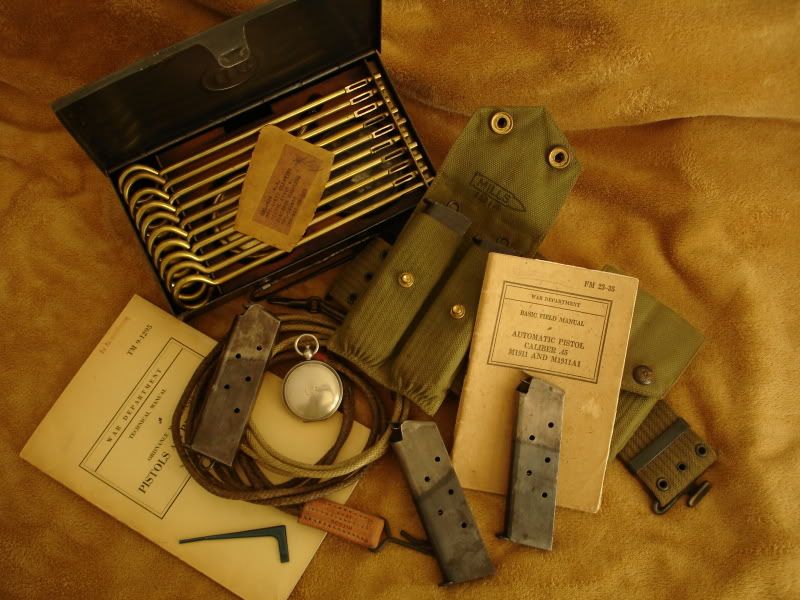
-
-
Very nice Scott, I love the compass. Nick -
Thanks Nick, it is a Waltham that was given to me a few years ago by a friend who collects military compasses. Come to think of it, I bought some of the other items in the photo from him also.Comment
-
Nice display. LOL I'm still trying to find brass rods for my M1912 box.They seem to be unobtanium.A man with a sword may talk of peace.A man with out a sword may talk of peace,but he must talk very fast indeed.Comment
-
My kit was complete when I bought it and the original bore brushes have never been used. The squad cleaning kits are very interesting to me and I need to find a WWII example someday.Comment
-
Are the brushes the fiber ones or brass?I put together a WW2 one quite easily from separate components picked up a piece at a time with the exception of the brushes.I found it was interesting the brass oilers are found easier than the steel ones although usually the brass ones are higher priced.If that is the nomenclature tag with the box could you post a clearer view?A man with a sword may talk of peace.A man with out a sword may talk of peace,but he must talk very fast indeed.Comment
-
Nice
Very nice display.
What postoli' does it all go with??
BradComment
-
The brushes are the early fiber type. I'll post a closeup of paper but it mainly shows unit information and really has nothing to do with the kit, although it was in it when I got it.Comment
-
Here is a closeup of the paper.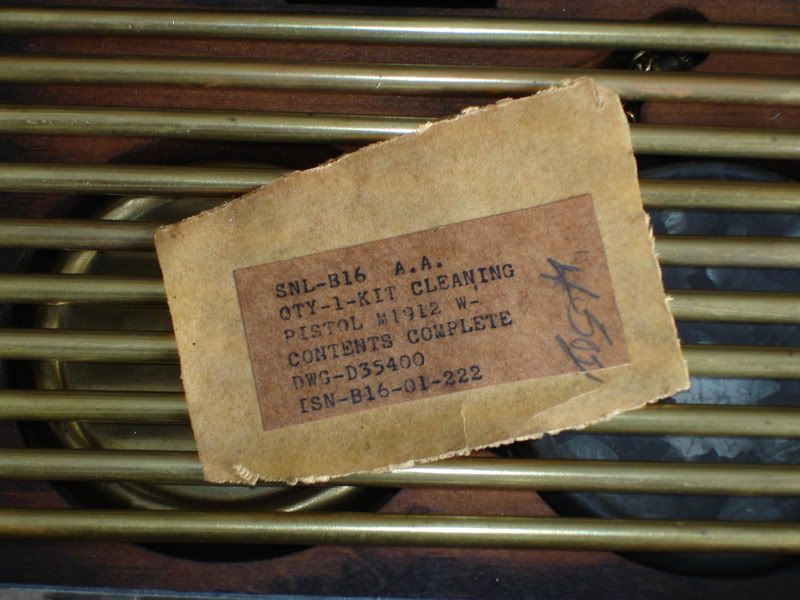
Comment
-
No , that IS part of the kit. That is the tag that was on the "shipping box" the kit was orig. packed in. The kit IS the M-1912. The DWG is the sheet of paper where all the specs and line drawings of the kit can be found. The "D" indicates the size of the sheet ( therefor what drawers it would be found ) and 35400 is the sheet number. These are the same numbers found on garand parts , like bolts , for example, that collectors go googoo over to find the right -x revision number to make correct. ISN and SNL numbers are for inventory control and reference to info on what is in the box without having to open it.
ChrisComment
-
Personally I think there was some sadistic SOB at Springfield, and after work one day stopped off at the local bar with some of his fellow workers. After several drinks he said "Hey! I know how we can screw with weapons collectors in the future. Let's start stamping all the parts with numbers! And every so often, we'll change the number on the part and leave no paperwork explaining why. That'll drive 'em nuts!"
Then another guy chimed in with "Yeah, we'll call the changes "revisions" and add a sequential number to the part. And sometimes we'll put a dash between the part number and the revision number, and sometimes we won't."
Then a third guy (a real wise guy) said "Hey! And then we'll stop marking certain parts and put no number at all!"
They all went home laughing their a$$es off!"No man's life, liberty, or property is safe, while Congress is in session." Mark TwainComment
-
Phillip McGregor (OFC)
"I am neither a fire arms nor a ballistics expert, but I was a combat infantry officer in the Great War, and I absolutely know that the bullet from an infantry rifle has to be able to shoot through things." General Douglas MacArthurComment
-
Is the grease/parts can galvanized finish? If so, probably a WWII repack.Comment


Comment