Ishapore Enfield 2A1

Collapse
X
 
  • Time
  • Show
Clear All
new posts
  • Brad in Idaho
    Senior Member
    • Sep 2009
    • 449

    #1

    Ishapore Enfield 2A1

    SEE LAST UPDATE ON THIS SUBJECT AT MY POST DATED 03-07-14

    Acquired this rifle some years back. It is in VG shape, and the bore is shiny with good rifling. Since I have another one that shoots well, I have never shot this one. I have been worried about what the yellow paint on the stock, across the top of the bolt and action signifies. Does anyone know why this paint was applied?

    Reposting this to see if anyone else has any further thoughts. I'm going to take this one to the range soon. I'll be shooting Radway Green NATO spec ammo as I did with my other "Ishy". Thanks

    Last edited by Brad in Idaho; 03-07-2014, 03:17. Reason: Update
  • p246
    Senior Member
    • Mar 2013
    • 2216

    #2
    Yellow paint meant bore safe to shoot but has some issue that made it not front line worthy...rust or pitting or wear,, etc. I've only been around one with yellow paint and it shot acceptable groups. Give us a range report.

    Comment

    • p246
      Senior Member
      • Mar 2013
      • 2216

      #3
      Looking at your picture again yellow paint does not appear to be up on hand guard. On the one I shot years ago paint went on hand guard to. Your hand guard could have been replaced, or that stock might be off another rifle and re issued. The yellow paint may not apply to your gun.

      Comment

      • Alan De Enfield
        Senior Member
        • Aug 2009
        • 152

        #4
        But there is yellow paint on the action as well.

        Yellow paint - safe to shoot, but as stated above, 'outside gauging limits' for front line use, kept in reserve or possibly used by cadets.

        Comment

        • Brad in Idaho
          Senior Member
          • Sep 2009
          • 449

          #5
          I suspect the handguard was replaced too, but there is paint on the action. I'll post a range report when I've tested it out. Thanks.

          Comment

          • JB White
            Senior Member
            • Aug 2009
            • 13371

            #6
            I was always under the impression the green-yellow-red code applied to Australia, not India. That India paint markings outside the red & white band were para-military/police/training rack markings.
            2016 Chicago Cubs. MLB Champions!


            **Never quite as old as the other old farts**

            Comment

            • Brad in Idaho
              Senior Member
              • Sep 2009
              • 449

              #7
              Originally posted by JB White
              I was always under the impression the green-yellow-red code applied to Australia, not India. That India paint markings outside the red & white band were para-military/police/training rack markings.
              That may very well be. I haven't been able to find any information which is why I asked here. Basically, I just wanted to make sure that the yellow paint didn't mean OMG DON'T EVER SHOOT THIS!!!. The rifle doesn't look beat up or overly worn anywhere, and has a pretty good looking bore. I'm comfortable with giving it a go.

              Comment

              • Brad in Idaho
                Senior Member
                • Sep 2009
                • 449

                #8
                A problem - update

                Took this rifle to the range yesterday after giving it a thorough going over and cleaning. The first shot is at 8 o'clock in the 10 ring of an SR1 target. Then the problem. I couldn't get the bolt to pull back. The extractor is engaged to the rim, it just won't move. I finally had to use my small hammer on the bolt to get it to move. Once the casing was extracted, I noticed it had a scratched spot near the web. Other than that it looked normal. Whether it was the smart thing to do or not, I repeated this 4 more times with the same result every time. At this point I decided not to fire it any more, and put it away. Please take a look at the pics below, and offer any thoughts you may have about what the problem might be.
                TIA, Brad

                I can't see anything obviously wrong with the chamber.


                This is the point where a spent casing won't go any further without being forced.


                These are the scratches on the spent casings. These were on every one.

                Comment

                • kcw
                  Senior Member
                  • Aug 2009
                  • 1173

                  #9
                  Are you certain that "scratch" in the 2nd pic actually isn't a stretch/crack, as in excessive headspace? Bolt & receiver #'s match? As to the 3rd pic, are those "dig" marks at the end of the case( at the bottom end of that mark), or is that a brass burr? Difficult to tell from the pic. If you simply drop a factory round into the chamber, will it chamber fully, or does it meet resistance before it properly bottoms?

                  Comment

                  • Rock
                    Senior Member
                    • Aug 2009
                    • 558

                    #10
                    There seems to be a burr on the edge of the extractor cutout where it meets the chamber. It corresponds to the position of the scratches on your cases. I looked at my rifle and it is very sharp in that area. Perhaps the extractor in your rifle battered the barrel cutout enough to push a burr of metal into the chamber. That could cause extraction problems. Smoothing that out shouldn't be difficult.

                    Comment

                    • Brad in Idaho
                      Senior Member
                      • Sep 2009
                      • 449

                      #11
                      Originally posted by kcw
                      Are you certain that "scratch" in the 2nd pic actually isn't a stretch/crack, as in excessive headspace? Bolt & receiver #'s match? As to the 3rd pic, are those "dig" marks at the end of the case( at the bottom end of that mark), or is that a brass burr? Difficult to tell from the pic. If you simply drop a factory round into the chamber, will it chamber fully, or does it meet resistance before it properly bottoms?
                      That scratch is nothing. I'm not even sure that brass came from the Enfield. It was just an illustration of how far in a spent casing went before having to be forced. It corresponds with how far the spent brass comes out before it extracts freely after firing.
                      Those are "dig" marks on the brass in the 3rd picture. The bolt and receiver numbers do not match. I have Forster head space gauges for .308. I removed the extractor from the bolt yesterday, and the bolt closed on the field gauge. Is the .308 gauge the proper one for this rifle or is there a 7.62X51 gauge? Would there be a difference?
                      A live round of the same ammo I was shooting in it drops smoothly into the chamber and drops out freely, so it is only after firing there is an issue. I'm beginning to think this may end up a parts gun.

                      Comment

                      • Brad in Idaho
                        Senior Member
                        • Sep 2009
                        • 449

                        #12
                        Originally posted by Rock
                        There seems to be a burr on the edge of the extractor cutout where it meets the chamber. It corresponds to the position of the scratches on your cases. I looked at my rifle and it is very sharp in that area. Perhaps the extractor in your rifle battered the barrel cutout enough to push a burr of metal into the chamber. That could cause extraction problems. Smoothing that out shouldn't be difficult.
                        Thanks Rock. I think you may be right, but I'm not sure the scratches correspond with the extractor cut. The range I was shooting at was pretty dark (cloudy day), and I really didn't notice those scratches until later, so I don't know for certain the position they were in when the brass came out of the chamber. I will look closer at that area. Actually I find it helps to take a picture. The camera picks those things up better than I can even with a magnifying glass. At any rate, if the headspace is an issue (see my reply to kcw above) it won't matter. I won't be shooting it any more.

                        Comment

                        • JB White
                          Senior Member
                          • Aug 2009
                          • 13371

                          #13
                          Brad, if there is a burr naturally it wil need to be addressed. FWIW I once had a sticky chamber in a 303 which also turned up similar results concerning difficult extraction, A bit of JB Bore Paste on a .45 cal mop spun in the chamber using a cordless drill remedied the stickiness and turned the rifle into a comfortable shooter. So, don't give up until you are certain there is a more serious problem.

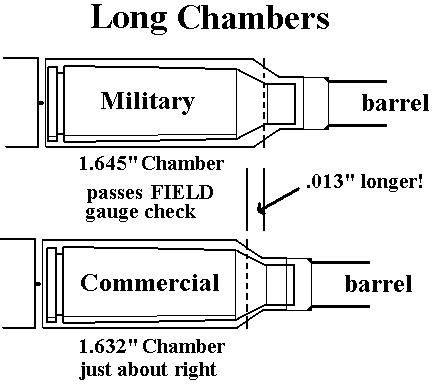
                          Also, keep in mind that our SAAMI spec gauges rarely serve us well on the 2A1 rifles. They (rifles) were made as a stop-gap arm during the transition from 303 British to the 7.62 NATO while the India version SLR's were first coming on line for main combat troops. The 2A series was intended for secondary use and the NATO chambering was more for logistical purposes at the time.
                          Since military and para-military forces consider cartridge cases a one-time use, (No reloading) the chambers were made a bit more oversized to compensate for possible crud and debris. RFI has not released their specs, being a functional government arms facility, so we really don't know for sure what their HS specs are. Since the majority of all the 2A/2A1 rifles show generous headspace with our HS gauges, the general consensus among collectors is they were made that way.

                          Our SAMMI specs are for sporting rifles using thinner brass, lighter webs, and take into consideration reloading. I don't think India was worried about those parameters when they needed rifles on their borders.***
                          If you get the thing working smoothly again without much effort, just remember to watch your NATO spec brass closely and only use commercial brass once for peace of mind.

                          ***Reference the Sino-India War and the Indo-Pakistani War if you want a little background which led to the development and use of your rifle.
                          Last edited by JB White; 02-23-2014, 11:29.
                          2016 Chicago Cubs. MLB Champions!


                          **Never quite as old as the other old farts**

                          Comment

                          • Brad in Idaho
                            Senior Member
                            • Sep 2009
                            • 449

                            #14
                            Thanks JB. I just tried another experiment. I had some once fired RG brass that I fired in my other 2A1 a couple of weeks ago. I inserted this fired brass in my other 2A1, and it had to be pushed in the last little bit by the bolt, BUT the extractor engaged it OK, and it extracted and ejected normally. Then I tried one of the once fired brass from the 2A1 with the problem in this other rifle, and it had the same problem as in the problem rifle. It didn't go in freely as far as the other spent brass, and the bolt had to be hammered on to extract the brass. When the brass was extracted, it had the same marks on it as in the 3rd picture. It appears the brass is expanding more in the chamber of the problem rifle than in the other one, making extraction difficult. I will try polishing the chamber as you describe and see if it helps. BTW I don't think I'll fire reloads in these rifles.

                            Comment

                            • Alan De Enfield
                              Senior Member
                              • Aug 2009
                              • 152

                              #15
                              Originally posted by JB White
                              .......... RFI has not released their specs, being a functional government arms facility, so we really don't know for sure what their HS specs are. Since the majority of all the 2A/2A1 rifles show generous headspace with our HS gauges, the general consensus among collectors is they were made that way.

                              .
                              Firstly - 308 HS gauges will not 'work' on 7.62 as the fundamental headspace is 13 thou different between the two.

                              However Peter Laidler has been 'working hard' for us and through the UK MOD's Indian Liasion Officer has obtained the following :

                              Information supplied by the Indian Liaison Officer to Peter Laidler

                              Don't say I don't try hard for you. The CHS for an Ishapore 2A1 is (They call it LOW) is GO 1.633" and HIGH or NO-GO is 1.642.

                              Now the observant of you will immediately see that this just about/almost/nearly/neatly inside the 7.62mm L1A1 limits of 1.6325 and 1.643". It's a bit higher that I would have expected from a bolt action rifle BUT, it is still the generally accepted .010" between go and no-go.

                              I don't know about Indian production at all. BUT, due to the fact that they made some of the rifles using bog standard old No1 bodies (which defeats the myth that they were made from higher quality steel - they weren't), it stands to reason that they'd use bog standard boltheads and bolts too. If they used different sizebolts and heads for the different calibres, then presumably, like any sensible person, they'd mark them, like we did with the 7.92mm/.303/7.62mm Bren bolts otherwise there would/could be a catastrophic failure.

                              On that basis, the chamber would be bored to a depth in relation to the breeching up geometry which ensured that when ithe barrel was breeched up, the distance from the datum line in the chamber to the face of the bolthead was between 1.633 and 1.642"

                              As for exactly which point in the neck that the Indian Engineers take their CHS datum from, well I can't answer due to the fact that I cannot calibrate an RFI set of CHS gauges against our own specification. BUT, at the risk of being wrong - as I was when I ventured to suggest originally that the CHS would be the same as the L39/42/96 etc etc, I'd say that it was the same datum as standard NATO.


                              So if you can get hold of a set of NATO 7.62 gauges then you can check - but - dont use 308 !!!

                              Comment

                              Working...