

 Tweet
Tweet
So I wonder what it will sell for....

Andy
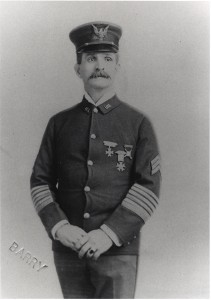
FABULOUS SPRINGFIELD MODEL 1873 SADDLE RING CARBINE THAT BELONGED TO CUSTER'S BUGLER JOHN MARTIN FORENSICALLY PROVEN TO HAVE FIRED A CARTRIDGE AT THE BATTLE OF THE LITTLE BIG HORN AND THE ONLY IDENTIFIED FIREARM EVER FOUND WHICH HAS BEEN PROVEN TO HAVE BEEN IMMEDIATELY WITH CUSTER DURING THE BATTLE. Cal. 45-55. Standard 1873 carbine with 22" bbl, barleycorn front sight & carbine ladder rear sight. Breech block has standard markings with the date "1873". Lock plate is likewise marked "1873" with the US Eagle in the center. Mounted in a 1-pc, uncheckered walnut stock secured with a single band that has a stacking swivel. Trigger guard is in 2 pieces, without sling swivel. Buttplate is standard carbine style without trap and neither is there a recess under the buttplate, signifying that this carbine did not receive the later updates. Left side of wrist has the outline of the "ESA" (Erskine S. Allin) cartouche. Left side of the stock has the sling bar, missing its ring, which was common practice among Indians with captured arms. Left side of forestock is crudely carved "J. MArTiN" and left side of buttstock is carved with an "H", ostensibly representing Company H of the 7th Cavalry to which Trooper Martin was assigned. The Martin carving shows moderate to heavy wear on the edges with heavy patina down in the cuts. The hammer screw has crystallized and broken. This carbine is well documented as having belonged to Custer's bugler, John Martin who was the individual to whom the famous note was given which read "Benteen / Come on. Big village / Be quick, Bring packs. / W.W. Cooke / P.S. Bring Pacs.". Martin subsequently recalled that Custer had called him over and said "Orderly, I want you to take a message to Benteen. Ride as fast as you can and tell him to hurry. Tell him it's a big village and I want him to be quick and bring the ammunition packs". He further recalled that Lt. Cooke called out "Wait Orderly" and pulled out a field order pad and wrote the above quoted note. Martin also recalled that Custer perused the note and called an orderly to deliver it. An unidentified trooper, probably another orderly came forward to which Custer said "No, No, the other man, Martin." As Martin took the dispatch Custer instructed, "Trumpeter, go back on our trail and see if you can discover Benteen and give him the message. If you see no danger come back to us. But if you find Indians in your way, stay with Benteen and return to him and when you get back to us, report". Martin apparently discovered Indians in the way, reporting that his horse was hit twice by rifle fire before he reached Benteen. He stayed with Benteen who, as we all know did not reach Custer in time. John Martin, an Italian immigrant, whose name was Giovanni Crisostomo Martino (or Martini, a sobriquet given to Martin by Major Benteen whose favorite drink was a martini). Martin had immigrated to the U.S. in 1873, settling in Brooklyn, NY. Prior to leaving Italy he had been a drummer boy in Italy's Army in 1866 in their war against Austria. John Martin enlisted in the US Army in 1874 as a Trumpeter and was assigned to Company H, US 7th Cavalry. Martin survived the battle and remained in the US Army fighting in the Nez Perce campaign in 1877 and then fought in the Spanish-American War and retired in 1904, having completed nearly 30 years of service. He died in December 1922, the result of injuries from a beer truck accident. In 1983 an accidental range fire burned some 700 acres of prairie including a large portion of the Custer battlefield. The result of this fire disclosed numerous artifacts, bones and articles from that battle. A team of volunteers and park personnel conducted a search using metal detectors and in the process uncovered hundreds of fired cartridge cases, bullets and other artifacts. A team of forensics experts from Nebraska began examining firing pin & extractor marks found on these cartridge cases and were able to identify them to cartridge cases fired for test purposes in various arms believed to have been at the Custer battlefield. One of the cartridge cases, identified as #707 was found about 10 feet from the monument on Custer Hill (Last Stand Hill) was forensically proven with at least 90% positive marks that this artifact cartridge case was fired in this carbine. Since we know that Trooper Martin was not with Custer on Last Stand Hill, but was with Capt. Benteen & Major Reno leaves one to speculate how this cartridge case could have been fired in his carbine at that location. Various theories have been proposed, the most likely of which is that 1). Trooper Martin discarded his carbine to prevent it banging on his horse during his frantic ride. 2). According to Trooper Martin's statements his horse was struck by rifle fire which would likely have disabled the horse and caused it to fall, leaving his carbine still attached to the saddle to be recovered by the Indians who then turned it on Custer's troops on Last Stand Hill. 3). That Trooper Martin had given his carbine to another trooper whose carbine had jammed or had been lost when he left Custer's command for his fateful ride. Obviously we will never know how this cartridge case came to be on Last Stand Hill, but there is no doubting the scientific evidence that cartridge case #707 was fired in this carbine. Bullets found on the battlefield, in some instances were discovered to have entered the dirt vertically which indicates that the Indians administered the "coup de gras" to wounded troopers by shooting directly down into their bodies. This seems to be the most likely reason that trooper Martins carbine was fired at Last Stand Hill in the position where it was found. Accompanied by a 4x6 cabinet photo of Trooper Martin in full uniform with medals by D.F. Barry of West Superior, WI. This carbine was the subject of a 2-page article by Donald Moore which appeared in the June 2013 issue of Wild West magazine. Additionally accompanied by a 7-page article about this carbine which appeared in the publication Military Classics Illustrated , date unknown. Also accompanying are copies of the original note carried by Trooper Martin to Capt. Benteen, which is currently at the US Army Military Academy, West Point, NY. Also accompanied by copies of 2 photographs of John Martin, one is dated 1879 depicting him as a young man seated with a bugle, with the caption "While he was called to testify at the Reno Court of Inquiry". Finally accompanied by the 138-page paperback book Archeological Insights Into The Custer Battle , Scott & Fox.
Andy



Comment