Antique RR watch

Collapse
X
 
  • Time
  • Show
Clear All
new posts
  • Johnny P
    Senior Member
    • Aug 2009
    • 6260

    #46
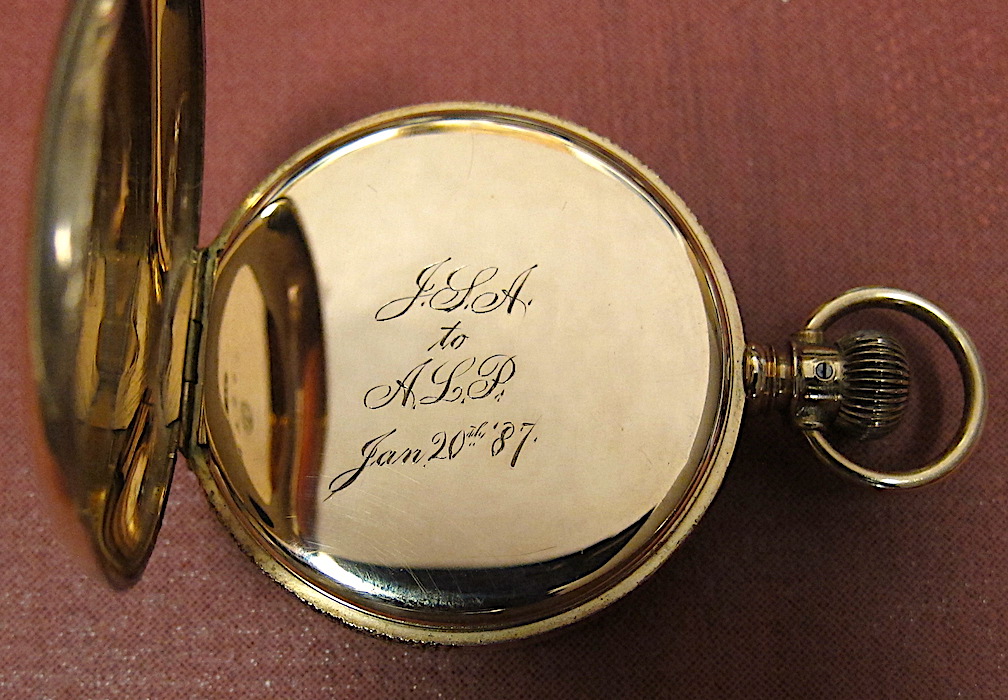
    My wife's mother inherited this watch, and then it was passed down to my wife. Very unusual with the multi-colored gold trim. My wife's mother had the works removed to wear it on a chain.

    Comment

    • Merc
      Senior Member
      • Feb 2016
      • 1690

      #47
      Originally posted by Johnny P
      My wife's mother inherited this watch, and then it was passed down to my wife. Very unusual with the multi-colored gold trim. My wife's mother had the works removed to wear it on a chain.
      Very nice, and if gold, valuable. Ladies watches and cases are usually in nice mechanical and cosmetic condition since they were never used daily. My wife’s grandmother’s 1907 6s 7j Elgin is a pendant watch and looks like it was made last week. It spent all its life in the dresser drawer. You see very few of them for sale, however. Do you still have the movement?

      Comment

      • Johnny P
        Senior Member
        • Aug 2009
        • 6260

        #48
        Yes. We found one of those cases made to keep watch movements in.

        Don't know anything about this one's history, but an American Waltham Watch Co. in a 14K rose gold case. Love the beautiful work on the inscription.

        Comment

        • Merc
          Senior Member
          • Feb 2016
          • 1690

          #49
          Originally posted by Johnny P
          Yes. We found one of those cases made to keep watch movements in.

          Don't know anything about this one's history, but an American Waltham Watch Co. in a 14K rose gold case. Love the beautiful work on the inscription.
          The inscribed date might add a little to the value of the case, but the detailed front cover is really something to see even with some gold loss around the edge. You would maximize the overall value by reinstalling the movement. (JMHO)

          Comment

          • Art
            Senior Member, Deceased
            • Dec 2009
            • 9256

            #50
            Originally posted by Merc
            The inscribed date might add a little to the value of the case, but the detailed front cover is really something to see even with some gold loss around the edge. You would maximize the overall value by reinstalling the movement. (JMHO)
            Absolutely true. If the movement isn't available or is unrepairable you might find one on line. There are a lot of movements available because so many cases were destroyed to harvest their gold during the precious metals bubbles leaving their movements to be had sometimes at very popular prices. I checked E-Bay and there were literally hundreds of movements for Elgins from scrap movements for parts to running movements. You'll find the same for all the other major manufacturers. Find the right size, stem or lever set and any watchmaker can clean it up and install it for you.

            Also I would be interested to know who made the case and the guarantee length. The warranty on the case is for the case only and is the number of years the watch can be carried before the gold clad (gold filled) finish wears through to the brass underneath. If a case is solid gold it will probably say "assay" and the karat gold content, usually 14k.
            Last edited by Art; 01-10-2019, 05:57. Reason: Clarity, completness

            Comment

            • Merc
              Senior Member
              • Feb 2016
              • 1690

              #51
              Originally posted by dryheat
              This is probably not a watch of any interest to you guys, but it's my dads old watch. I always thought it was "railroad approved" for some reason. A jeweler told me it wasn't very valuable. The watch next to it was my moms. Of course they mean a lot to me.

              [ATTACH=CONFIG]44910[/ATTACH]
              One of the interesting, although sad aspects of the history of early watches equipped with radium dials was the short life span of the watch factory workers who hand-painted the hour numbers on the dials and watch hands with the radium paint. The process was changed once the manufacturers realized that their workers were dying of radio active poisoning from being exposed to the radium in the paint. The women dial painters found it was easier to paint the numbers if the brush bristles were formed into a tiny point and they did this by twirling the brush in their mouths.

              Comment

              • Art
                Senior Member, Deceased
                • Dec 2009
                • 9256

                #52
                Originally posted by Merc
                One of the interesting, although sad aspects of the history of early watches equipped with radium dials was the short life span of the watch factory workers who hand-painted the hour numbers on the dials and watch hands with the radium paint. The process was changed once the manufacturers realized that their workers were dying of radio active poisoning from being exposed to the radium in the paint. The women dial painters found it was easier to paint the numbers if the brush bristles were formed into a tiny point and they did this by twirling the brush in their mouths.
                The same was true of early X-ray machines. A lot of doctors, nurses, and some patients had their lives significantly shortened by exposure to X-rays. An old radiologist told me of a doctor who had awful consequences in the early 20th century because he would hold the spots being X-rayed on people in place with his hand. It can take a while to realize how dangerous a new technology or product can be.

                Comment

                • oscars
                  Senior Member
                  • Nov 2009
                  • 551

                  #53
                  I also remember buying shoes as a kid and being Xrayed to determine fit of the shoe.

                  Comment

                  • Merc
                    Senior Member
                    • Feb 2016
                    • 1690

                    #54
                    The Elgin RR watch continues to impress me. I adjusted the regulator over a period of several days and finally achieved sync with a quartz Wittenaur wristwatch. Both have been running in sync for 2 days. As good as this mechanical movement is, I doubted it’s ability to match a quartz. Not bad for an 80 year old watch. The RRs required plus or minus 30 seconds per week.

                    Comment

                    • PWC
                      Senior Member
                      • Aug 2009
                      • 1366

                      #55
                      I am not a Horologist, but I love old watches. It depresses me to see, on the Antique Roadshow, a 1700's watch wound with a separate key that is worth $700 and a confiderate sword that is worth $5000.

                      As far as accuracy, a $15 electronic wristwatch is more accurate than the most accurate (old) wind up pocket watch.

                      Comment

                      • dryheat
                        Senior Member
                        • Sep 2009
                        • 10587

                        #56
                        I finally narrowed it down a little about my dads watch. Lot's of sites and about 300 pictures. I saw a bunch of watches that were close, but the unique thing about my watch is the military time band is on the inside of the numerals, not out near the edge. No little segments of seconds. It's a "time only" as opposed to a chronograph equipt'd. Probably the most basic 1930's-40's watch you can find. Military style.
                        I found out most of this on a hip website that covers all COOl stuff. Booze, food, whatever cool dudes should know. Gear Patrol.
                        Watches-You-Should-Know-Longines-Sei-Tre-Tacche-gear-patrol-lead-full.jpg

                        This isn't my exact watch but it's what they used in the article(I did find one closer but didn't think to dnload it).

                        -While Longines’s chronograph production in the 1940s was robust, the production of simpler three-hand watches was prolific. Using the technology it had honed in the development of its chronographs, Longines was able to produce reliable time-only watches that were shock-, dust- and water-resistant. These watches were characterized by small steel cases (30-32mm) with tapered lugs and simple stepped bezels. While some of these time-only watches were produced under contract for various militaries, many more were produced for the consumer market. Most utilized the venerable Longines calibre 12.68z, a robust, manual-wind movement with anti-shock protection, though some also utilized the 27M with its sub-seconds layout.-

                        These watches were so common they didn't get fancy names. I did see a Calatrava that looked a little similar but it was a sei(6) tacche(notch).

                        This has been fun. Oh, and thanks to Art and Merc for the links and information. Stuff like this might get me enticed to look into watches. I sure have seen some beauties in the last couple of days. My better sense knows I know .01% about watches. But a real RR280 would be cool, or one of those nice Elgins...

                        By the way, why can't Timex make one of those press button-glow in the dark indiglo watches that lasts more than a year? It's the perfect dark middle of the night camping watch.

                        Another question: If my watch was made in the 30's-40's then it must not have radium painted hands. By 1925 the effects were well known(from what I read). So it's some other kind of phosphorous?
                        Last edited by dryheat; 01-11-2019, 07:57.
                        If I should die before I wake...great,a little more sleep.

                        Comment

                        • Merc
                          Senior Member
                          • Feb 2016
                          • 1690

                          #57
                          Originally posted by PWC
                          I am not a Horologist, but I love old watches. It depresses me to see, on the Antique Roadshow, a 1700's watch wound with a separate key that is worth $700 and a confiderate sword that is worth $5000.

                          As far as accuracy, a $15 electronic wristwatch is more accurate than the most accurate (old) wind up pocket watch.
                          PWC, I hear you and agree. The price of any antique is usually driven by three things. Rarity, rarity and rarity. Confederate swords are so rare that they are almost impossible to find on the open market. Collectors are everywhere, hence the demand is incredible. If you do find one, the seller usually knows what he has and wants a fortune for it. I’m in Gettysburg several times each year scouting the antique shops and it’s rare that ANY confederate artifacts are offered for sale.

                          While the really old English key wound watches from the 1700s might also be rare, fewer people collect them and that might be the reason the demand isn’t as strong. I admire the really old watches for the engineering that went into building them, and the fact that they paved the way for the mass-produced US watches of the mid 1800s. I’d definitely be a buyer if one presented itself however, the only 1700s watches I’ve ever seen are in museums.

                          You’re correct. The modern quartz watches are the pinnacle of accuracy. Even the really cheap ones will usually outperform the most expensive mechanical watches. The Bulova Accutron revolutionized the watch building business. Will the $15 watches still be working 50 or 100 years from now? No, like the Dollar Watches, they were designed to be thrown away when they stop working. I own quite a few of both varieties and like to wear my 1966 Seiko 26j automatic even though it’s not as accurate as the other watch that I like to wear which is a 1980s big quartz chronograph also made by Seiko.

                          The latest watches are medical monitors and mini computers. Remember Dick Tracy and his two way wrist radio?

                          Comment

                          • Merc
                            Senior Member
                            • Feb 2016
                            • 1690

                            #58
                            Originally posted by dryheat
                            I finally narrowed it down a little about my dads watch. Lot's of sites and about 300 pictures. I saw a bunch of watches that were close, but the unique thing about my watch is the military time band is on the inside of the numerals, not out near the edge. No little segments of seconds. It's a "time only" as opposed to a chronograph equipt'd. Probably the most basic 1930's-40's watch you can find. Military style.
                            I found out most of this on a hip website that covers all COOl stuff. Booze, food, whatever cool dudes should know. Gear Patrol.
                            [ATTACH=CONFIG]44927[/ATTACH]

                            This isn't my exact watch but it's what they used in the article(I did find one closer but didn't think to dnload it).

                            -While Longines’s chronograph production in the 1940s was robust, the production of simpler three-hand watches was prolific. Using the technology it had honed in the development of its chronographs, Longines was able to produce reliable time-only watches that were shock-, dust- and water-resistant. These watches were characterized by small steel cases (30-32mm) with tapered lugs and simple stepped bezels. While some of these time-only watches were produced under contract for various militaries, many more were produced for the consumer market. Most utilized the venerable Longines calibre 12.68z, a robust, manual-wind movement with anti-shock protection, though some also utilized the 27M with its sub-seconds layout.-

                            These watches were so common they didn't get fancy names. I did see a Calatrava that looked a little similar but it was a sei(6) tacche(notch).

                            This has been fun. Oh, and thanks to Art and Merc for the links and information. Stuff like this might get me enticed to look into watches. I sure have seen some beauties in the last couple of days. My better sense knows I know .01% about watches. But a real RR280 would be cool, or one of those nice Elgins...

                            By the way, why can't Timex make one of those press button-glow in the dark indiglo watches that lasts more than a year? It's the perfect dark middle of the night camping watch.

                            Another question: If my watch was made in the 30's-40's then it must not have radium painted dials. By 1925 the effects were well known(from what I read). So it's some other kind of phosphorous?
                            Let me be the first to welcome you to watch collecting (if you decide to jump in and join us), just as you and many others welcomed me to the gun collecting world a few years ago when I knew almost zero about guns. Like Art said, most gun collectors also have an interest in watches or vice versa. We just like mechanical things that took lots of engineering and thought to build. Stick with the watches that were made in the US by the major manufacturers. It’s nice to be able to hold the first mass produced US product in your hand that still works. You have a choice of acquiring the modestly priced common watches of which there are plenty out there to choose from, or opt for the better, more expensive RR grade 21j and 23j beauties that cost a little more. Either way, it’s lots of fun.

                            I’ll do some research on the radium dial and let you know if I find anything. The question would be, did they continue using radium and just stop hand painting the dials or did they switch to a different luminous coating and what would that be?

                            Forget the Timex and use the digital clock on your cell phone at night.

                            Comment

                            • dryheat
                              Senior Member
                              • Sep 2009
                              • 10587

                              #59
                              Good point; maybe they still used it, they just stopped putting it in their mouths. That was a hundred yrs ago. I'm thinking in the present. The EPA was still a long way away.
                              If I should die before I wake...great,a little more sleep.

                              Comment

                              • Merc
                                Senior Member
                                • Feb 2016
                                • 1690

                                #60
                                I read several articles on the subject. It appears that the use of radium paint on watch dials and aircraft instruments continued through WW2. Radium levels the women dial painters were exposed to still persisted but at much lower levels than before. They knew by then what activity to avoid in order to minimize exposure. At least they weren’t swallowing a dose of radiation hundreds of times daily.

                                Comment

                                Working...