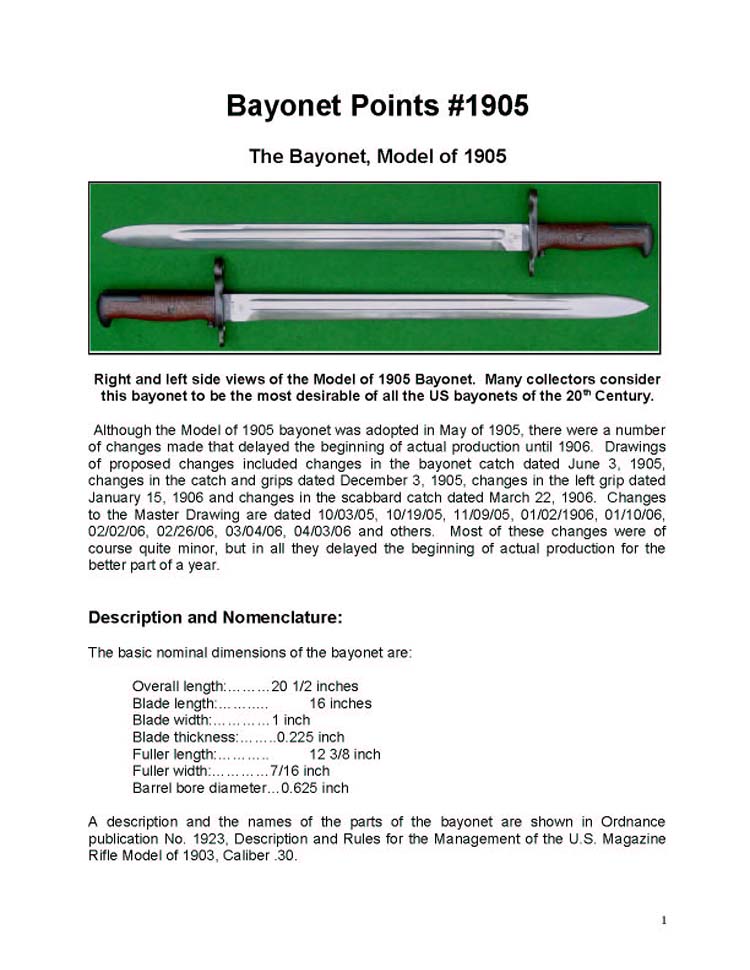
Detailed photo's of two 1905 bayonets

Collapse
X
 
  • Time
  • Show
Clear All
new posts
  • Fred
    Senior Member
    • Sep 2009
    • 4977

    #16
    Thanks Emri. Yes, I was aware of what Rick was talking about. However I didn't know that that it was part of the heat treat process. Interesting. Thanks.

    The bluing done by the USMC to some 1905 blades that I was referring to in my above post was that which was referred to by Steve (cplnorton) in another thread in link below...

    http://www.jouster.com/forums/showth...vass-equipment

    I'd never before heard of that.
    Last edited by Fred; 04-18-2015, 04:11.

    Comment

    • Emri
      Senior Member
      • Aug 2009
      • 1649

      #17
      Originally posted by Fred
      Thanks Emri. Yes, I was aware of what Rick was talking about. However I didn't know that that it was part of the heat treat process. Interesting. Thanks.
      You're welcome,

      The blades had to be heat treated in such a manner as to be slightly flexible if bent somewhat. The rear end had to be hardened so as to not wear from frequent mounting and dismounting. The whole blade was bright until the rear end was dipped in cyanide (??) to harden it, creating the color as an aside.
      I still stand by my comments about why one of yours may be light blue and have darker spots due to surface rust ( though maybe not enough exposure to pit the metal).

      Emri

      Comment

      • Fred
        Senior Member
        • Sep 2009
        • 4977

        #18
        That's got to be it then Emri. I just can't see the oxidation occurring from contact with gold spray paint. I think that the oxidation of the blade must have already occurred before the paint was applied. The darkening actually reminds me of a carbon steel knife that's been allowed to lay unwashed after using it to cut meat.

        Comment

        • Fred
          Senior Member
          • Sep 2009
          • 4977

          #19
          By the way Emri, Thank You for that information on how the 1905 blades were heat treated. That certainly is interesting! I knew about cyanide being used to harden the bayonet lugs, but I never knew it was used on those blades. Thanks!

          Comment

          • CPC
            Senior Member
            • Aug 2009
            • 365

            #20
            As Gary Cunningham alludes to in his bayopoints 42 article not all the bayonets were blued at arsenals and maybe this was a poor attempt done in the field or at unit level. Or maybe it was done in France using the Italian process, whatever that was.

            Regards,
            CC

            Comment

            • Emri
              Senior Member
              • Aug 2009
              • 1649

              #21
              Originally posted by Fred
              By the way Emri, Thank You for that information on how the 1905 blades were heat treated. That certainly is interesting! I knew about cyanide being used to harden the bayonet lugs, but I never knew it was used on those blades. Thanks!
              Again, you're welcome. I can't remember where I was reading about the manufacturing process. It may have been the article CPC mentioned by Gary Cunningham. I have that one somewhere. It may have been in Brophy. I would think the book Rick mentioned by Gary Cunningham should have it in there also.

              Emri

              Comment

              • Emri
                Senior Member
                • Aug 2009
                • 1649

                #22
                Fred,

                I gave you bad info. That is what I get for trying to go by memory alone. The "blue line" is from actual blueing ( browning ). The pommel was not dipped in cyanide to harden it. The whole blade was heat treated consistantly along its entire length. The bayonet catch however WAS hardened in cyanide. I am easily confused sometimes.

                I checked myself by looking up the manufacturing process in Colvin & Vail and re-reading Gary Cunningham's bayonet points 42. It is good reading, here is a link.


                I do remember reading somewhere about testing the blades as they did have to flex somewhat without breaking but return to straight. I still don't remember where I read that.

                I'll double check next time before posting what I think I know.

                Emri

                Comment

                • Fred
                  Senior Member
                  • Sep 2009
                  • 4977

                  #23
                  Oh! OK. Thanks for the correction Emri!

                  Comment

                  Working...