

 Tweet
Tweet
Thanks again Richard. I forgot but I also have both Poyer's and Bophy's books. I should have checked the books. It's clear to me now that they used parts/sections of the early 03 and 05 slings to assemble 07 pattern slings. The sling is now residing on my 1903 RI that has all correct, not assembled from RB or 30/03 rifle dated parts but was made in the 1st year of normal production in the 6th month of 1907. I think an appropriate sling for that rifle. Ray
-
Last edited by rayg; 08-15-2015, 05:33. -
Ray:
Just glad that you and Hal have one of these slings and appreciate how the M1907 was born. When I first started making slings in 1988, it was just another item I could make along with holsters, saddles, scabbards, and other miscellaneous items. I rapidly realized that trying to make the most authentic sling was where it was at. It wasn't but a few years later, that I was the only one making an arsenal correct sling and just about everything else I was making fell by the wayside. I remember the wife (Camille) saying in 1991, her Dad, a Pharmacy Professor and Assistant Dean @ Auburn University, thought I had lost my mind when she told him after 14 years, I was leaving the Marine Corps to make rifle slings. He said there has to be only so many rifles and eventually I would have no work, but he was wrong. I finished out my time in the USMC Reserves and we are still going strong today. It hurt real bad to have to pony up the money last year for dies in order to make the frogs (hooks), but since our supplier discontinued the part, it was start making our own or go out of business. Heading into our 27th year next month, and at age 58, it has been a good ride no matter what the future holds. I just appreciate all the folks who have stood by us all these years, as several times I have been tempted to throw in the towel.
Most have probably seen the several post I made last year on the various forums about the new frogs. It also prompted me to write a fairly detailed history of how it all began and credit those who have helped along the way. Here is a link to the most active post over on the CMP Forums.
http://forums.thecmp.org/showthread.php?t=143280
History is where it is at. Glad collectors like yourself, Fred, and Hal, are out there trying to document and preserve the past. I don't profess to know everything about slings, but I do appreciate any and all assistance in the area of slings, because very little has been documented.
RichardComment
-
I still have one question.
Both mine and OP's sling have 32-34 pr of holes in the long length and 16 pr in the short length.
The standard M1907 slings have 16 pr of holes in both lengths.
I understand the using of 2 older slings to make one. But if they were going to make them to conform to the M1907 pattern sling, why not the same amount of holes why add all those extra holes. My mind just can't let go of the fact that these two slings were not made as a standard M1907. I can see no other reason why so many extra holes were added unless they could be pre M1907 trials/prototype slings. My sling is also 2 inches shorter then a 1907 sling.
It would seem that if they were making a M1907 pattern sling out of old sling parts, why not the normal 16 pr's of holes as that would be an easy fit on most of the salvaged older sling sections. Also there are no older slings that have that many holes in them already that I'm aware of. So it would seem that many extra holes had to be intentionally added? Maybe the harness maker or arsenal worker just decided to add that many holes, Who knows, but here are two slings made the same with more holes then the M1907 sling has. That could indicate they may be a trials pattern and a pre 1907 sling. Would love to have some one else post that they have one just like it also.
Richard I remember your post on making the hooks, read it with interest. Also did I buy an original Russian SVT sling from you a couple year ago? If I recall right you found a few original slings and used them as a pattern to make them and sold the originals off and which I bought one of the originals, Ray.Last edited by rayg; 08-17-2015, 10:54.Comment
-
Ray:
In an ideal world, with the utilization of the M1887, M1903, and M1905 slings (all had 20 pair of holes) to make the new model M1907 sling, on the long strap you should have 20 pair of holes beginning at the hook end and 10 pair of holes beginning at the other end (feed end), for a total of 30 pair of holes total punched in the long strap. Reason for the minimum of 20 pair of holes starting at the hook end is due to the fact that each of the slings used to make the conversion originally had 20 pair of holes.
I noticed in your photo (Post #3), that your sling only has 8 pair of holes; however, it appears that the end has been cut, kind of straight across with definite corners, rather than having the semi rounded profile specified in the drawings. Also you stated that your sling is two inches shorter than a M1907 sling, which most likely answers the fact that you only have 8 pair of holes at the feed end vice the required 10 pair.
We are not dealing with a mint pristine piece of gear in either example, and it was very common for troops to add extra holes and make modifications as necessary. I began using the M1907 sling in 1978 while assigned to various USMC Shooting Teams and at times many, including myself, would punch extra holes when needed in our issue M1907 slings. It was so common that the team captain usually had a rotary hole punch in the team shooting box, if not, the armory usually had one available. As I have told many, it is easy to add extra holes, but real tough to remove holes.
If you notice in the OP's photo of the short strap, it actually has 17 pair of holes (one pair at the heel of the hook) and the specs only specified 16 pair for the short strap and it was made from a M1903 sling as evidenced in the photo of the back of the sewn section at the "D" ring. Most likely reason for the 17 pair of holes was they were trying to achieve the 24" - 25" finished length per the original drawings for the short strap.
I don't know what else I can say or provide, other than the fact that Rock Island ordered that 106,470 M1907 slings be produced from earlier surplus slings and I'm sure many of these slings had already been modified and extra holes punched when needed.
This is the cleanest early drawing I have of the M1907, dated Jan 1916. It shows the length of the long strap to be 47" inches (length of leather).
If anyone wants to be picky, all the specs I have ever seen calls for oval or oblong holes, including specs for the length and width of the hole; however, I have seen many M1907 slings with round holes, mostly made by the various contractors in WWI and WWII, not to mention all the variations of the gun sling hooks in both brass and steel. I have collected at least a dozen or more with different point styles and widths from scrap slings over the years, even though there was only one specification and style of hook to be used. I have seen early hooks that were cast bronze when the specs called for the hook to be stamped from brass and formed.
[IMG]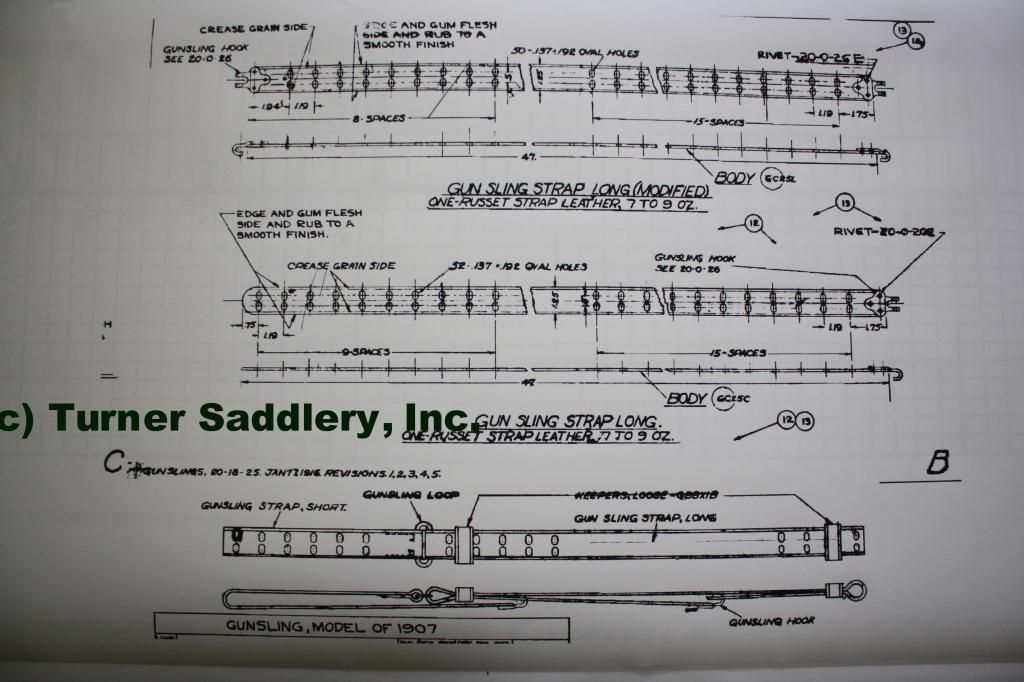 [/IMG]
We have been talking about slings, but you will see modifications on various pieces of gear such as the M6 Knife Scabbard for the M3 Trench Knife. The M6 Scabbard required a wire belt hanger to be stitched and riveted at the top. Due to the fact that many paratroopers shoved the scabbard in their boot instead of hanging it on their cartridge belt, they cut the wire hanger off so the top portion could be folded over and tied around the scabbard body with a boot lace, another field modification. I have had many say the scabbard was another variant, but there is no evidence, just evidence that a soldier cut the belt hanger off. I have a rifle scabbard originally made for the M1903, later it was modified for the M1 Garand by being cut for the op rod and the brass shroud added. Then it underwent another modification, someone riveted a 2" wide strap about 12" long at the throat. The added strap has a long oval slit allowing the scabbard to be hung on a vehicle, aircraft, or maybe on a saddle horn. Even though the McClellan Saddles had no horn, the M1913 Mule Saddle had a brass saddle horn as did the driving saddle used on horse and mule teams and the horse cavalry didn't die until toward the end of WWII.
RichardComment
-
Thanks Richard, that puts to rest my question. I finally went and looked at a couple of my1887 slings to finally see what you meant, RayComment

Comment