-
-
I know UK troops still (occasionally) refer to the M4/M16 as an "Armalite". Nowadays, some US troops bandy the term "Stoner" here and there but they are usually referring the to early Knights Armament SR-25s.Last edited by Guest; 10-04-2014, 04:53.Comment
-
The troops turned in their 1903s when they reached France and were issued 1917s, i.e. the British rifle, not SMLE. Sgt York may very well have re-acquired a 1903 as there is a significant amount of evidence that was what he was carrying when he won the Medal of Honor.LeHavre, France: So we got to France at Le Havre. There we turned in our guns and got British guns. Well, we went out from Le Havre to a little inland camp. I had taken a liking to my gun by this time. I had taken it apart and cleaned it enough to learn every piece and I could almost put it back together with my eyes shut. The Greeks and Italians were improving. They had stayed continuously on the rifle range for a month or two and got so they could shoot well. They were fairly good pals, too. But I missed the Tennesseans. I was the only mountaineer in the platoon. I didn't like the British guns so well. I don't think they were as accurate as our American rifles. Ho ho.
Also note there is no further comment on rifle swaps. It is a case where using the right designation rather than slang would have made it clearer but you can pick it out of the context and happenings.
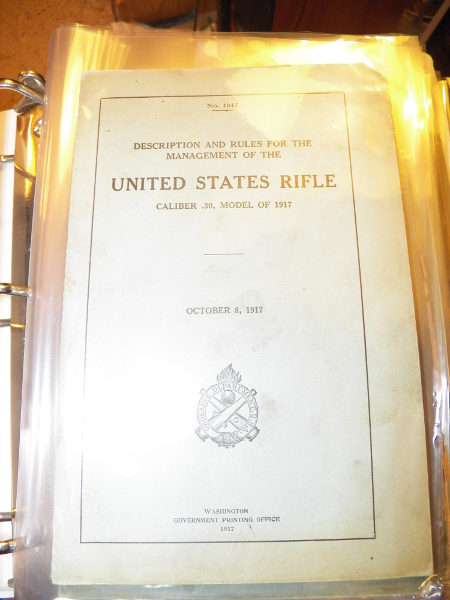
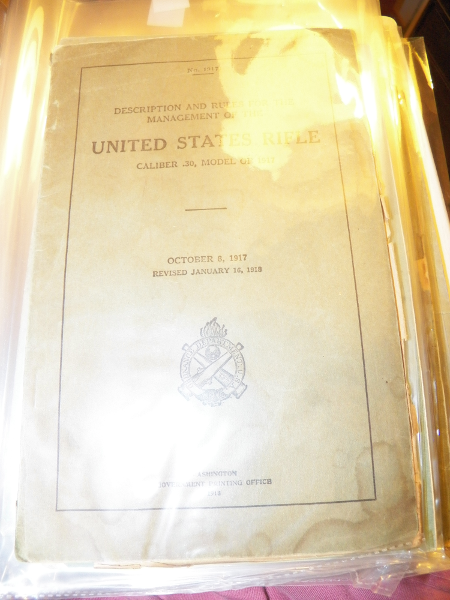
However, the procedure was to de-issue US troops the 1903s as the 1917 was the standardized rifle. Due to its history and its commonality in looks with the Pattern 13 (and the pamphlet that specifically did refer to its inherent from Enfield) it would easily have been referred to "as that British Rifle" in somewhat dismisely terms for someone who was not reared on peep sights.
Montsec Sector, France-- And we relieved the 26th Div. boys at night in the Montsec Sector at Rambucourt and we stayed there until the 4th of July.
It was a quiet sector, where they put new troops to train them before sending them out into no man's land. The Greeks and Italians did fairly well. I was out in no man's land. I did a right smart piece of patrolling, handling an automatic squad.
We had a lot of big stuff from the artillery coming over, and now and then a gas shell. The only firing we had then was from the snipers. We were new troops and we were nervous and jumpy at first. And when those pesky bullets came humming and buzzing a round our ears, just like a lot of mad hornets or bumblebees when you rob their nests at home in Tennessee, we used to do a powerful lot of ducking.
But soon we realized it was no use. You never hear the one that gets you.Last edited by RC20; 10-04-2014, 07:17.Comment
-
The troops never had 1903s. I have the shipment records for the M-1917 rifles being sent to their cantonment. None of the National Army divisions had M-1903s. There is a picture of his division parading in Paris - they have their M-1917s. There is a picture of the division parading in their cantonment - they have their M-1917s. At no time were they issued M-1903s. That was a National Army division.
Repeat, no National Army divisions had M-1903s.
So tell me what this "evidence" you have is.
What slang is that? His "Springfield rifle?" The one he cleaned the cosmoline from? I have the shipment record for the Krags sent to his cantonment. They trained on Krags until the M-1917s arrived.Also note there is no further comment on rifle swaps. It is a case where using the right designation rather than slang would have made it clearer but you can pick it out of the context and happenings.
Why do you make sh!t up? What procedures are these? Citation please. Find me a single record for any M-1903s shipped to the National Army cantonments. I have the records for the Krags, M-1917s and the M-1917 bayonets shipped to them. Show me any for M-1903s.However, the procedure was to de-issue US troops the 1903s as the 1917 was the standardized rifle.
The unit was issued SMLEs in France. They turned in their M-1917s for that. When orders were changed they retreived their M-1917s.Due to its history and its commonality in looks with the Pattern 13 (and the pamphlet that specifically did refer to its inherent from Enfield) it would easily have been referred to "as that British Rifle" in somewhat dismisely terms for someone who was not reared on peep sights.
Find me a single record for any M-1903s shipped to National Army units.
Find me a single picture of anyone from that division with an M-1903.
Your evidence is sadly lacking. Mine I have in spades.
Please don't waste our time with assertions sans evidence. A single picture of that division with M-1903s, a single document of them having them, anything specifically mentioning his division and the M-1903.
It doesn't exist. It doesn't exist because the only rifles they were ever issued were Krags, M-1917s, and SMLEs. The documents are very clear.Last edited by 5MadFarmers; 10-04-2014, 08:12.Comment
-
I'm going to pile on that one a bit. Far too many people tend to make stuff up and then it gets repeated until it becomes "the truth." Even Canfield fell for that "British Rifle" thing.
The story of the M-1917 is a long and involved one. I gave it serious research. Primary sources. Lots of them. I know when somebody really did research on them as they'll have those records. I do. If they don't have those records they didn't bother looking. Something as basic has reading the official Division history. The "British rifle" account was easy to find and very clear. If people won't even take the time to read that how much work have they done to back up their opinions with fact? None.
The Krag book is almost done. As part of that I covered the Krag usage in depth. To include the usage in the cantonments during WW1. That lead me down some other paths. The "Lewis gun" controversy. The "great rifle shortage." Researched it all to get a context for the issue and usage of those Krags. You can't study that without taking a good hard look at the M-1917s and the Nagants. The deeper you dig the more obvious what occurred. The Ordnance Department really effed up. Badly. Bad enough where when the war was over Congress helpfully offered to abolish them. They were counterproductive.
The entire story of the M-1917 is facinating. No, I'm not going to do a book on it though. I have other stuff I'm after.
That said collectors of the M-1917 rifle should bear in mind that the M-1917 was there when the M-1903 failed the nation. The "cult" of the M-1903 has tried to get around that. Julian Hatcher lied by ommission on how bad the M-1903 situation was. I cover it in my book. Using ordnance department documents.
The M-1917 rifle essentially replaced the M-1903 for good reason. The regular army and the national guard had M-1903s. The national army divisions were without rifles. The "broomstick apologists," to use Teddy Roosevelt's term, in the Ordnance Department were screwed. They lied to congress repeatedly. The Chief of Ordnance was removed from his job. With the dam that was the Ordnance Department removed the M-1917 production commenced in a volume that was staggering. The national guard units were partially equiped with M-1917s when the war ended. All the national army divisions had them throughout. Given a bit more time and all the troops in France, perhaps excepting the USMC, would have had them.
The cult of the M-1903 and the cult of Alvin York is interesting. So far from reality. They just can't get over it. 100 years later and that cult is still in place. That's simply astonishing.Comment
-
This is from the 328th's history written some time in 1919
Page 7
The original line officers of the regiment were chosen from officers commissioned
in the Fourth and Eighth Companies, First Officers Training Camp, Fort McPherson,
Georgia. Each companv was assigned two or three men from Regular Army outfits
to assist in training the men. The officers assigned to each company together with
these Regulars constituted the companies until September 5th, 1917, on which date
the first five per cent, of the Selective Draft for Camp Gordon began to arrive. These
men were from the States of Alabama, Georgia and Tennessee. Work now began in
earnest along the lines of training and building up a smooth running organization
and getting the Regimental area into a fit training ground. New men were arriving
daily so that by the middle of October each company had approximately fifty per
cent, of its authorized full strength. It is impossible to enumerate the many difficulties
which were encountered and overcome during this period due to lack of experience
on the part of the officers and men and also lack of equipment; nevertheless,
each day showed progress and the transition from civilian to soldier was progressing
rapidly. Regimental, Battalion and Company organizations were perfected,
schools for N. C. O.'s and also Bakers and Cooks were inaugurated and the "Camp
Gordon 1917 Model"' rifle in the shape of a five-foot pole was very much in evidence.
Page 9
Clothing and equipment was being received and issued daily and soon the
percentage of straw hats and tennis shoes at dress parades was on the decline. Saw
mills of the camp were rapidly turning out the "new model" Camp Gordon rifle and
soon each man was busily occupied in mastering the intricacies of the manual of
arms with this bed slat variety of fire arm. Work continued with this makeshift
equipment till about the first of February, 1918. Then we were fully equipped with
the United States Model 1917 Rifle and Bayonet.
Pages 11 & 13
Parades and reviews were held weekly, culminating in the Division being reviewed
on April 4th, 1918, by Mrs. John B. Gordon, wife of Gen. John B. Gordon,
C. S. A., for whom the camp was named. The officer personnel while at Camp Gordon
had undergone many changes—some of the original officers being transferred
to other branches of the Service and others lost by promotion, while new officers
from the Second Training Camp were assigned to the Regiment. Rumors had been
rampant for weeks, gradually assuming a more official tone till the middle of April,
when the Regimental advance party was ordered to a port of embarkation and then
we knew that our time of departure was close at hand.
All drills had been suspended and everything was orderly confusion during the
last two weeks of our stay at Gordon. Property was boxed and marked, as per regulations,
clothing and equipment issued and stenciled, passenger and baggage lists
typed and show down inspections held at all hours of the day and night to determine
any shortages. Entraining orders were received and on April 19th, 1918, Headquarters,
Machine Gun and Supply Companies left for Camp Upton, followed shortly thereafter
by the balance of the Regiment.
Page 308
Alvin C. York, Joined Company February 9. 1918. Appointed Sergeant
Pall Mall, Tenn. November 1, 1918. Awarded D. S. C. for meritorious action
West of Chatel Chehery, on October 8, 1918.
-------------------------------------------------------
This tells me the 328th crated up their 1917s and hauled them to Europe. So some where along the line York and possibly a couple of his buddies picked up some 1903s and were ordered turn in the '03s and draw the rifle type they were issued. Can't prove it though.Last edited by CJCulpeper; 10-05-2014, 01:37.1."If you would be a real seeker after truth, it is necessary that at least once in your life you doubt, as far as possible, all things." - Rene Descartes
2. "The Right to Buy Weapons is the Right to be Free" From The Weapon Shop by A. E. van VogtComment
-
interesting sir. thanks for postingComment
-
CJCulpeper--
Thanks for posting references to the 328th's. It helps clear up a lot of the Sgt York myth about his rifle. I believe a lot the myth stems from the Sgt York movie inwhich Cary Cooper played Sgt York. In the movie he uses a captured German Luger and a Springfield rifle while in reality he probably used a Model of 1911, Colt .45 ACP and a Model of 1917, .30-06 Rifle.
Just as side note, as a general rule, I believe in most troop movements in a wartime, the individual soldier would have kept his rifle, field gear (pup tent, mess kit, etc.) and personal hygiene items with them. Even in recent "wartime" deployments, we always took our individual weapons with us. That's not to say that changes could happen once you are physically in the war zone. I was upgraded from my M9 to a M16A2 once I hit the war zone in Iraq in the 2nd Gulf war.
--fjrupleLast edited by fjruple; 10-05-2014, 04:17.Comment
-
I miswrote when I put down York and the 1903. The Historical Commitee goes on:
Page 19
On May 20th Col. Lindsey received his promotion to Brigadier General and was
assigned to command of the 164th Brigade, Major Jewett being placed in command
of the Regiment. On this date the last of our regiment embarked for France and
the next morning found us winding our weary way up the hill to rest camps Nos.
1 and 2, about five miles from Le Havre. Here we learned that our division was to
be brigaded with the British and our baggage in the future would be confined to
what we carried on our backs. The time was spent in turning in American rifles and
bayonets and drawing British equipment and salvaging a large majority of the
equipment issued us at Camp Upton. Barrack bags most of which have never been
seen since, were left for storage, and shortly thereafter the officers learned that of
the 250 pounds of overseas equipment required to be brought by them they could
retain 50 pounds, including bedding rolls. At this place we were issued gas masks
and steel helmets and passed through a gas chamber where each man thoroughly
tested the efficiency of his mask, realizing fully that his life might depend upon it
in the future.
page 25
During our stay here officers and men from each Battalion and Company were
sent to the front line trenches to get first hand information as to the work done there.
After three weeks training with the British, evidently with the view of taking over a
sector here, orders were changed, and we turned in all our British equipment, again
drew American arms in their place, and on June 16th the Regiment entrained for an
American sector.
--------------------------------------------------------
So if they traveled with all of their gear from Gordon then they would have been carrying the Model of 1917. The record is silent on what was the British rifle. And it is silent on what they drew when they turned in the British stuff.
CulpeperLast edited by CJCulpeper; 10-05-2014, 07:36.1."If you would be a real seeker after truth, it is necessary that at least once in your life you doubt, as far as possible, all things." - Rene Descartes
2. "The Right to Buy Weapons is the Right to be Free" From The Weapon Shop by A. E. van VogtComment
-
[QUOTE]Plain and simple I was wrong and divisions I apologize and salute the people who know far more than I do I got an in depth history of the 82nd in WWI and per your citation, they were issued Lee Enfield.
If you make assumption you get egg on your face and I have a whole carton full.
I missed the piece about the 1917s being the original standard issue. that puts a twist on the discussion of what he carried.
What's also confusing is the subsequent evidence that Sgt York insisted the 1903 was the right rifle for movie depiction. It has me scratching my head. I don't have the quotes but his son insisted and supposedly he did as well.
With all due respect and my appologiesLast edited by RC20; 10-05-2014, 10:48.Comment
-
This is a further quote of the 82nd history. Very accurate per the previous documentation though it specifically states their original 1917s being re-issued (and the Chauchot and Hotchkiss were issued). What machine gun were they equiped with before?
Early in June, details of officers and non-commissioned
officers were guests of British front-line units in the new
trenches before Albert and Amiens, where the lines were
becoming newly stabilized after the upheaval which fol-
lowed the successful enemy offensive of March 21, 1918.
It v\^as during one of these tours of duty that Captain
Jewett Williams, 326th Infantry, was killed, June 9, 1918,
the first casualty in action from the 82nd Division. It
was generally assumed by both British and American of-
ficers that the American battalions were to be attached
immediately to British brigades and share the honors and
burdens of redeeming the lost battlefields of Picardy. This
assumption was suddenly overturned by an order entrain-
ing the Division for destination near Toul. The Lee-En-
field rifles, to which the troops had just become accustomed,
and the Lewis automatic rifles and Vickers machine guns
were turned back to the British, and the U. S. 1917 Rifle
(Eddystone) was reissued. The train movement began
June 16, 1918, and lasted two full days. The Division
occupied towns and villages north of Toul, and once again
addressed itself to the task of obtaining and mastering
new weapons.The Infantry received Chauchot automatic rifles, and
machine gun companies were equipped with the French
8-mm. Hotchkiss machine guns. At this time all units
of the Division, except the 157th Field Artillery Brigade,
joined the Command. The artillery, however, remained in
training at La Courtine, FranceLast edited by RC20; 10-05-2014, 11:08.Comment
-
Difference between National Guard and National Army division?None of the National Army divisions had M-1903s. There is a picture of his division parading in Paris - they have their M-1917s. There is a picture of the division parading in their cantonment - they have their M-1917s. At no time were they issued M-1903s. That was a National Army division.
And who got the 1903s?
My personal feeling on the 1903 vs the 1917 is if I was an average grunt, I would have preferred the 1903. It handles better and the bolts operations a lot better (and the original 1903s are better than the 1903A3s (and yes I have an early 1903 and handled several other of the WWI era 1903s)
However, as a shooter I like the 1917. That would be my preference, I always have been a slower shooter and prefer the accuracy you get from that as I can’t shoot fast and accurate.
The 1917 peep setup and long sight distance and good square front post are a delight let alone for my now older yes.Last edited by RC20; 10-05-2014, 11:34.Comment
-
What part would be a typo? The Army of WW1 was comprised of three segments: Regular Army (Divs 1-25), National Guard (26-74), and National Army (75+). So what part is a typo?
Congrats - you found it. I mentioned it before:This is a further quote of the 82nd history. Very accurate per the previous documentation
That makes you one of the very few who take the time to poke at it. Travel back a few pages and you'll find they were Eddystones. There is a caveat to that but you'll not find it in that tome - you have to find the shipping records.The story of the M-1917 is a long and involved one. I gave it serious research. Primary sources. Lots of them. I know when somebody really did research on them as they'll have those records. I do. If they don't have those records they didn't bother looking. Something as basic has reading the official Division history. The "British rifle" account was easy to find and very clear. If people won't even take the time to read that how much work have they done to back up their opinions with fact? None.
If you're real interested there is a picture of Company G taken in 1917 at Camp Gordon. York is in the photo. Clearly in evidence are the M-1917 rifles.....
Do you know why I do the research I do? I don't like being a parrot. When I first started with this stuff I by default believed the "facts" bandied about. A number of them made no sense logically. So I started digging. I don't like being a parrot. The M-1903 cult will have people being a parrot in no time. They've built years building a story to support the M-1903. None of it is real.
Don't sweat it. It's hard to erase all of that supposed knowledge. You took the time to find the division history. That's a positive.
Best wishes.Comment
-
Unlike my boss I think details matter and facts should to (grin)
I appreciate your courtesy, while not intentional I certainly put my foot into it. Obviously shipping records I would not have a clue where to look. I did read Sgt Yorks diary for clarification but that also obviously has to be taken in context of the other facts.
Have you published this under on article write-up? It would be a great reference and a convincing counter. I am verging on definitive. Great work.
Certainly I can use the discussion here and the 82nd history, Prior to this discussion I had not read the details that have been brought out.
Who did get the 1903s? Regular Army?
I was not familiar with the three terms of service units in WWI. National Army got translated as National Guard. A bit of searching and I see the confusing mix that developed.
I have been back and forth on the Sgt York 1917 issue, if anything weighed me in the direction of the 1903 it was the reported family insistence (at least reported) that it was a 1903. If you have any clarification on that it would be appreciate. Not that it changes anything, I like to understand how things got where they did.
I also did not want to attribute an event to the 1917 that belonged to the 1903 just because I am enamored with the 1917 (which I did not know existed two years ago let alone its history). I have a small collection now.
I like the 1903, my dads re-barreled 1903 Sporter is one hell of a shooter (scoped). Occasionally I can get 5/8 to 3/4 MOA with it.
I have to get my non intrusive mount back on my 1917s and see how I do now I have a good load sorted out for them.Comment
-
Last edited by CJCulpeper; 10-05-2014, 02:21.1."If you would be a real seeker after truth, it is necessary that at least once in your life you doubt, as far as possible, all things." - Rene Descartes
2. "The Right to Buy Weapons is the Right to be Free" From The Weapon Shop by A. E. van VogtComment

 Tweet
Tweet


Comment